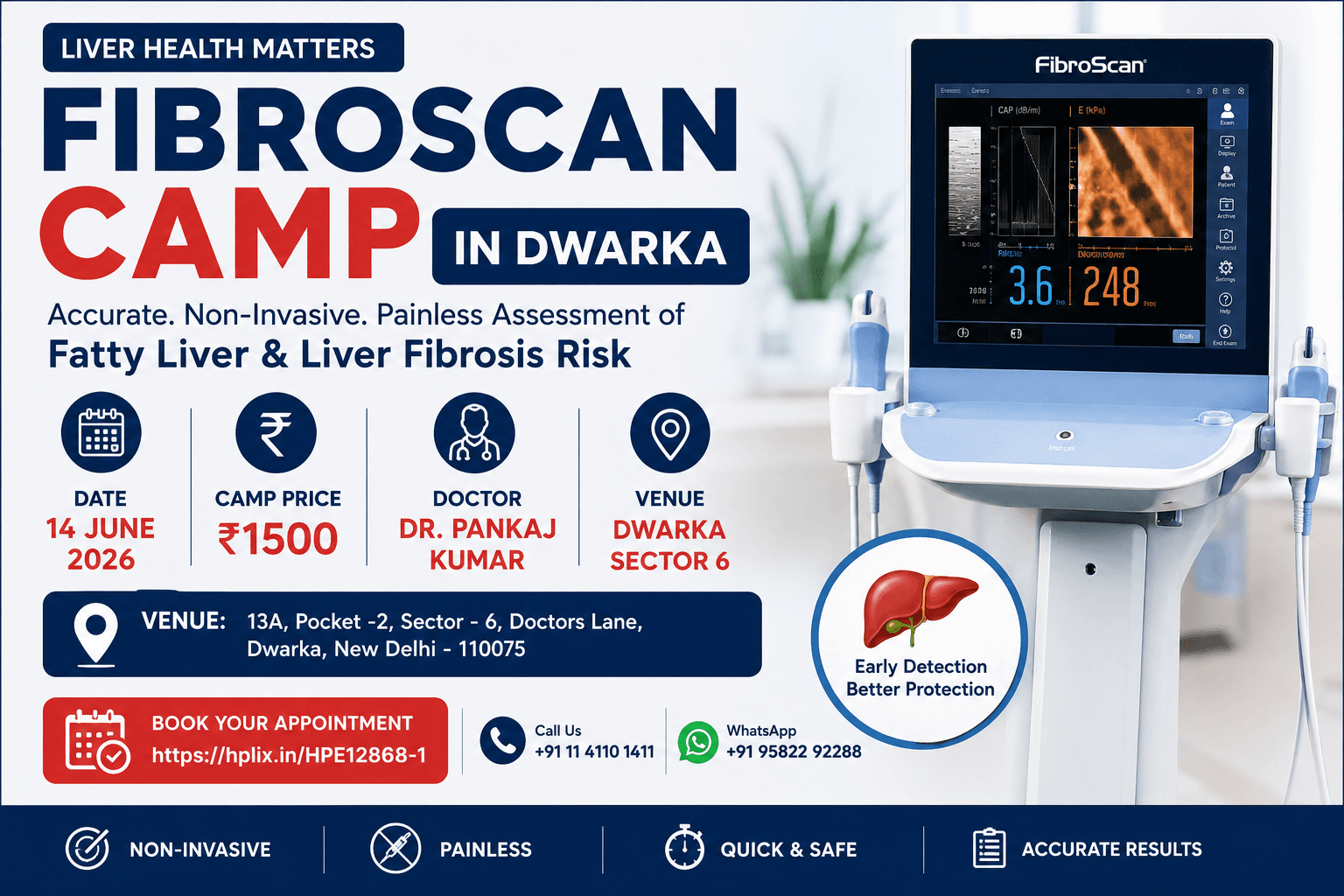
A doctor-supervised FibroScan Camp in Dwarka is being organised
on 14 June 2026 for people who need assessment of fatty liver,
liver stiffness and possible liver fibrosis risk. The test will be available
at the special camp price of ₹1500.
14 June 2026
₹1500
Dr. Pankaj Kumar
Dwarka Sector 6
Venue: 13A, Pocket -2, Sector – 6, Doctors Lane,
Dwarka, New Delhi – 110075
FibroScan Camp Details at a Glance
Why Is This FibroScan Camp in Dwarka Being Organised?
Fatty liver is now one of the most frequent findings during routine ultrasound
examinations and preventive health check-ups. Some people discover it while
undergoing tests for diabetes, obesity, high cholesterol or high triglycerides.
Others are advised an ultrasound because of abdominal discomfort, persistent
tiredness or abnormal liver enzymes.
The term fatty liver may sound simple, but an ultrasound report alone does not
always tell us whether the liver has only accumulated fat or whether there is
also a possibility of increased liver stiffness and fibrosis.
Liver fibrosis refers to the formation of scar tissue after ongoing liver
injury. It may develop gradually and can remain silent during the early stages.
A person may have no pain, jaundice or obvious symptoms even when further
assessment is clinically appropriate.
This camp is being organised to make non-invasive liver assessment more
accessible for people with relevant risk factors. It is not intended to
frighten every person who has fatty liver or encourage unnecessary testing.
The aim is to identify people who may benefit from timely evaluation, medical
guidance and structured lifestyle modification.
The Purpose of Testing Is Clarity, Not Fear
A FibroScan report can provide additional information about liver stiffness
and fat-related changes. However, it should always be reviewed along with
medical history, blood tests, ultrasound findings, diabetes status, body
weight and other clinical risk factors.
What Is a FibroScan Test?
FibroScan is the commonly used name for a non-invasive test based on transient
elastography. It estimates the stiffness of liver tissue. Depending on the
machine and available parameters, it may also provide an estimate of fat
accumulation within the liver.
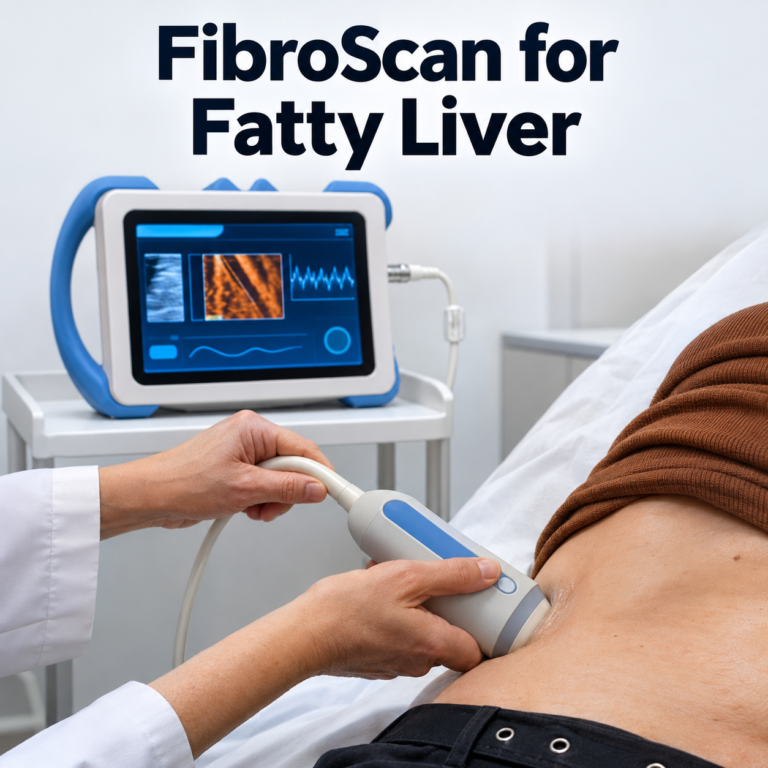
During the procedure, a probe is placed over the right upper abdomen. The
machine sends a small vibration through the liver and measures the speed at
which the resulting wave travels through the tissue. This information is then
used to calculate liver stiffness.
The procedure does not involve needles, injections, surgical cuts or ionising
radiation. Most people describe it as painless, although they may feel a light
tapping sensation from the probe.
Several readings are normally taken because the device requires a set of
technically acceptable measurements before generating a result. The test itself
is usually completed quickly, although registration, waiting and report
coordination may increase the overall visit time.
Why Fatty Liver Should Not Be Ignored
Fatty liver means that excess fat has accumulated within liver cells. In many
patients, it is closely linked with insulin resistance, diabetes, increased
waist circumference, high triglycerides, low physical activity and other
components of metabolic syndrome.
The condition does not progress at the same rate in every person. Some patients
remain at relatively low risk, particularly when metabolic factors are addressed
early. Others may develop ongoing liver inflammation and gradual fibrosis.
The absence of symptoms does not confirm that the liver is healthy. Many people
with fatty liver or early fibrosis feel completely normal. Liver enzymes may
also remain within the laboratory reference range in some patients despite
underlying metabolic liver disease.
This is why liver assessment should not depend only on symptoms or one SGPT
report. Age, diabetes, platelet count, AST, ALT, alcohol intake, ultrasound
findings and other clinical factors may all influence the decision.
not automatically mean that fibrosis risk is absent. Ultrasound can identify
visible fatty changes, but it does not reliably stage early liver fibrosis.
Who Should Consider a FibroScan Test?
FibroScan may be useful for adults with a known liver condition or relevant
metabolic risk factors. The final decision should depend on medical judgement.
Fatty Liver on Ultrasound
FibroScan may provide additional information about liver stiffness when
fatty liver has already been detected on imaging.
Diabetes or Prediabetes
Type 2 diabetes and fatty liver frequently occur together and may increase
the need for fibrosis-risk assessment.
Obesity or Abdominal Fat
Increased waist circumference and insulin resistance can be important
even when BMI is not extremely high.
High Triglycerides
High triglycerides, low HDL, hypertension and raised blood sugar often
occur together as part of metabolic syndrome.
Abnormal Liver Enzymes
Repeated elevation of SGPT, SGOT or GGT requires proper evaluation rather
than treatment based only on one laboratory report.
Regular Alcohol Intake
Alcohol exposure can affect liver health and should be discussed honestly
during medical assessment.
Other reasons may include long-standing fatty liver, family history of liver
disease, a previous abnormal fibrosis score, low platelet count or an older
report suggesting increased liver stiffness.
Ultrasound and FibroScan: What Is the Difference?
Ultrasound and FibroScan are both non-invasive tests, but they answer different
clinical questions.
| Feature | Ultrasound Abdomen | FibroScan |
|---|---|---|
| Main purpose | Examines the structure of abdominal organs | Estimates liver stiffness and fat-related parameters |
| Fatty liver | Can identify visible fatty changes | May provide a numerical fat-related measurement |
| Liver fibrosis | Does not reliably stage early fibrosis | Helps estimate fibrosis risk using stiffness measurement |
| Other organs | Can assess the gallbladder, kidneys, spleen and other organs | Primarily focuses on the liver |
| Radiation | No ionising radiation | No ionising radiation |
One test does not automatically replace the other. Some patients may require
an ultrasound for structural assessment and FibroScan for non-invasive
evaluation of liver stiffness.
What Does a FibroScan Report Measure?
Liver Stiffness Measurement
Liver stiffness is usually reported in kilopascals, written as kPa. A higher
reading can be associated with a greater probability of fibrosis, but its
meaning depends on the underlying liver condition, the quality of the readings
and the patient’s clinical profile.
There is no single universal cut-off that should be applied to every person.
Values may be interpreted differently in metabolic fatty liver disease,
alcohol-related liver disease, viral hepatitis and other liver conditions.
Controlled Attenuation Parameter
Many FibroScan devices also provide a controlled attenuation parameter, known
as CAP. This measurement is used as an estimate related to fat accumulation
in the liver.
CAP and liver stiffness assess different aspects of liver health. A high
fat-related reading does not automatically mean that advanced fibrosis is
present. Similarly, a lower stiffness reading does not mean that fatty liver
can be ignored.
Measurement Quality
The number of valid measurements and the variation between those measurements
are also relevant. A report should not be interpreted only by looking at one
large number printed on the page.
FibroScan Test Cost During the Dwarka Camp
The FibroScan test will be available during the camp for
₹1500.
At many diagnostic facilities, FibroScan testing may cost approximately
₹5000–₹7000. The actual rate can vary according to the centre, location,
machine, consultation inclusion and other factors.
The reduced camp price is intended to improve access for people with relevant
risk factors. It should not be interpreted as a recommendation that every
adult must undergo the test.
Camp Booking Information
Date: 14 June 2026
Camp Price: ₹1500
Venue: 13A, Pocket -2, Sector – 6, Doctors Lane,
Dwarka, New Delhi – 110075
How to Prepare Before the FibroScan Test
Follow the preparation instructions provided by the clinic at the time of
booking. Recent food intake can influence liver stiffness readings, so
patients are commonly advised to avoid eating for a specified period before
the test.
- Follow the fasting instructions given during booking.
- Do not stop prescribed medicines unless specifically advised.
- Wear comfortable clothing that allows access to the right upper abdomen.
- Reach the clinic at the scheduled time.
- Carry previous medical reports and prescriptions.
- Inform the clinic about pregnancy, fluid in the abdomen or implanted devices.
- Disclose recent illness, alcohol intake and medication use honestly.
on your own merely because fasting has been advised.
Which Medical Reports Should You Bring?
FibroScan results become more meaningful when interpreted with your previous
medical information. Bring the following reports if available:
Liver Reports
- Ultrasound abdomen
- Liver function test
- SGPT and SGOT
- GGT and bilirubin
- Previous FibroScan report
Metabolic Reports
- Fasting blood sugar
- HbA1c
- Lipid profile
- Kidney function test
- Thyroid profile, if relevant
Other Relevant Records
- Complete blood count
- Platelet count
- Hepatitis B or C reports
- Current prescription
- Specialist consultation notes
Do not delay your appointment only because every report is unavailable.
Bring whatever records you currently have and discuss whether further
investigation is required.
What Happens During a FibroScan Test?
Positioning
You will usually lie on the examination couch with the right arm positioned
above or behind your head. This exposes the area over the liver.
Probe Placement
A small quantity of gel is applied to the skin. The probe is then placed
between the ribs over the right upper abdomen.
Measurements
You may feel a light tapping sensation as the device records several
readings. Multiple measurements help improve technical reliability.
Completion
The test is normally painless and does not require anesthesia, injections
or blood collection.
Return to Routine Activity
Most people can return to normal activities immediately after the test
unless another medical condition requires restriction.
How Should a FibroScan Report Be Interpreted?
A FibroScan report should not be interpreted by matching one number with a
random chart found online. The clinical meaning depends on several factors.
Underlying Cause of Liver Disease
Stiffness thresholds may vary depending on whether the condition is related
to metabolic fatty liver disease, alcohol use, viral hepatitis or another
chronic liver disorder.
Recent Food Intake
Eating shortly before the test can affect liver stiffness readings. This is
one reason proper preparation is important.
Inflammation and Acute Illness
Active liver inflammation or an acute illness may temporarily raise liver
stiffness. A raised value does not always mean that permanent scarring is
present at the same level.
Body Composition and Technical Factors
Obesity, narrow rib spaces and other technical factors may affect the ability
to obtain reliable readings. A different probe may be required for some
patients.
Blood-Test Findings
Platelet count, albumin, bilirubin, AST, ALT and other laboratory reports help
place the result in context. Blood-based fibrosis scores may also be considered.
Do Not Panic Over One Number
A higher reading requires proper medical evaluation, not immediate
assumptions. A lower reading can be reassuring, but it does not remove the
need to manage diabetes, obesity, alcohol exposure, triglycerides or fatty
liver.
What Happens After the FibroScan Test?
The next step depends on the result and the patient’s overall medical profile.
A single generic treatment plan is not suitable for everyone.
Lower-Risk Result
A lower stiffness measurement can be reassuring, but metabolic risk
factors may still require treatment and follow-up.
Indeterminate Result
The doctor may review test quality, blood-based scores or recommend repeat
testing or another investigation.
Higher-Risk Result
Further blood tests, detailed imaging, closer monitoring or referral to a
gastroenterologist or hepatologist may be advised.
Fatty Liver Is Closely Connected With Metabolic Health
Fatty liver should not be viewed only as an isolated liver problem. In many
patients, it is one visible part of broader metabolic dysfunction.
Insulin resistance can promote greater fat delivery to the liver and increased
liver-fat production. The same metabolic pattern may contribute to high blood
sugar, abdominal obesity, raised triglycerides and cardiovascular risk.
A clinically appropriate plan may therefore include improvement in meal
quality, protein adequacy, fibre intake, portion structure, alcohol exposure,
physical activity, strength training, sleep, stress and diabetes management.
Patients should be cautious about extreme liver-detox diets, juice cleanses,
unregulated supplements and crash diets. Such approaches may be nutritionally
inadequate, interact with medicines or delay appropriate evaluation.
Can Fatty Liver Improve?
Fatty liver and associated metabolic abnormalities can improve in many
patients when the underlying drivers are properly addressed. The degree of
improvement depends on the stage of disease, diabetes control, body composition,
alcohol intake, medicines, adherence and other health conditions.
Improvement should not be judged only by body weight. Waist circumference,
liver enzymes, blood sugar, triglycerides, blood pressure, fitness, strength
and repeat liver assessment may all provide useful information.
Sustainable lifestyle modification is more useful than a short restrictive
plan. The aim should be improved metabolic health, not rapid weight loss at
the cost of muscle mass.
Why People With Diabetes Need to Pay Attention to Liver Health
Type 2 diabetes and metabolic fatty liver disease are closely connected.
Insulin resistance is an important feature of both conditions.
A person with diabetes may have fatty liver without liver-related symptoms.
Normal bilirubin or the absence of jaundice does not confirm that fibrosis
risk is absent.
The purpose of screening is not to perform every test in every patient. It is
to identify those who may benefit from secondary assessment and avoid missing
clinically important liver disease.
Can a Person With Normal Weight Have Fatty Liver?
Yes. Fatty liver is more common among people with overweight or obesity, but
it can also occur in those whose BMI falls within the conventional normal
range.
This is particularly relevant among South Asian populations, where insulin
resistance and abdominal fat may develop at comparatively lower BMI values.
Waist circumference, muscle mass, family history, activity level and blood
reports can provide information that BMI alone cannot.
Important Limitations of FibroScan
- It does not identify every possible cause of liver disease.
- It does not replace a complete medical history and examination.
- It does not provide the same anatomical imaging as an ultrasound.
- It does not independently diagnose liver inflammation.
- Recent food intake can influence stiffness measurements.
- Acute inflammation may produce a temporarily higher reading.
- Severe obesity and technical factors can reduce measurement reliability.
- A lower-risk result does not mean metabolic risks can be ignored.
- A higher reading should not be treated as a final diagnosis by itself.
Patients should not make decisions about medicines, supplements, alcohol,
diet or specialist referral based solely on the printed FibroScan value.
Doctor-Supervised Guidance After Liver Assessment
The approach at the clinic combines medical evaluation with practical
lifestyle modification. The purpose is not to prescribe crash diets or
promise rapid liver detoxification.
Depending on the patient’s condition, the plan may address diabetes control,
waist reduction, triglycerides, meal composition, protein adequacy, walking,
strength training, sleep, stress and alcohol intake.
Medicines may be required for diabetes, hypertension, dyslipidaemia or other
associated health conditions. Significant fibrosis risk or unexplained liver
abnormalities may require referral to a gastroenterologist or hepatologist.
How to Book the FibroScan Camp in Dwarka
Prior booking is recommended because testing will be conducted through
scheduled appointment slots.
Date: 14 June 2026
Camp Price: ₹1500
Venue: 13A, Pocket -2, Sector – 6, Doctors Lane,
Dwarka, New Delhi – 110075
Phone: +91 11 4110 1411
Mobile / WhatsApp: +91 95822 92277
Related Liver and Metabolic Health Services
Learn more about our
FibroScan Test in Dwarka,
fatty liver consultation in Dwarka,
diabetes treatment in Dwarka,
and
doctor-supervised Lifestyle Modification Program.
You can also learn more about
Dr. Pankaj Kumar
and the clinic’s approach to metabolic health management.
Frequently Asked Questions About the FibroScan Camp
When is the FibroScan Camp in Dwarka?
The camp is scheduled for 14 June 2026. Prior appointment booking is
recommended.
Where is the camp being held?
The venue is 13A, Pocket -2, Sector – 6, Doctors Lane, Dwarka,
New Delhi – 110075.
What is the FibroScan camp price?
The test is available during the camp for ₹1500.
How can I book an appointment?
Book through the
online appointment link
,
call +91 11 4110 1411 or contact +91 95822 92277.
Is FibroScan painful?
No. The procedure is generally painless. You may feel a light tapping
sensation while the measurements are being recorded.
Does FibroScan involve radiation?
No. Transient elastography does not use ionizing radiation.
Is fasting required before FibroScan?
Patients are commonly advised to avoid food for a specified period because
recent food intake can affect the reading. Follow the instructions provided
when booking.
Should I stop my medicines before the test?
Do not stop prescribed medicines unless your doctor or the clinic has
specifically advised you to do so.
How long does the test take?
The measurement itself generally takes only a few minutes. Registration,
waiting and repeated readings may increase the total visit duration.
Can FibroScan diagnose cirrhosis?
A high liver stiffness measurement may suggest an increased probability of
advanced fibrosis, but final diagnosis requires medical evaluation and
additional investigations where appropriate.
Is FibroScan better than ultrasound?
The two tests have different purposes. Ultrasound provides structural
imaging, while FibroScan estimates liver stiffness and fat-related
parameters.
Do I need FibroScan if my SGPT is normal?
Normal SGPT does not always exclude fatty liver or fibrosis risk. The need
for testing depends on diabetes, age, ultrasound findings, platelet count
and other clinical factors.
Can a person without obesity have fatty liver?
Yes. Fatty liver can occur in people with a normal BMI, especially when
abdominal fat, insulin resistance, diabetes or high triglycerides are present.
What should I bring to the camp?
Bring previous ultrasound reports, liver function tests, complete blood
count, HbA1c, lipid profile, prescriptions and any previous FibroScan report.
Can I attend without an appointment?
Walk-in availability cannot be guaranteed. Advance booking is recommended
because camp slots are limited.
Book Your FibroScan Camp Appointment
Consider timely liver assessment if you have fatty liver, diabetes, obesity,
high triglycerides, repeated elevation of liver enzymes, regular alcohol
intake or another relevant risk factor.
The aim is to understand liver health more clearly and decide whether lifestyle
correction, medical follow-up, further investigation or specialist referral
is required.
Medical Disclaimer
This article is intended for health education and information about the
scheduled camp. It does not provide an individual diagnosis or treatment
plan. The need for FibroScan and interpretation of its results depend on
clinical history, examination, blood tests, imaging and other relevant
medical information.
People with severe abdominal pain, vomiting blood, black stools, confusion,
breathing difficulty, worsening jaundice, abdominal swelling or another urgent
symptom should seek immediate medical care rather than waiting for a camp
appointment.
Related

Written by Dr. Pankaj Kumar
General & Lifestyle Physician in Dwarka Sector 6, New Delhi · MBBS, DNB (Family Medicine), DNHE · 16 years of experience.
About the doctor →Book a consultation → Beyond Blood Sugar
 The 90-Day Prediabetes Turnaround
 The Indian Diabetes Diet Reset
 Eat to Beat Gout
 Why Is My Hair Falling?
 The 30-Day Inflammation Reset