You go to sleep without eating for several hours, wake up, check your glucose—and the number is higher than expected.
Morning high blood sugar can feel confusing because no breakfast has been eaten yet. But glucose levels are influenced by much more than food. During the night and early morning, the liver releases glucose, hormones affect insulin sensitivity, diabetes medicines may begin to wear off, and glucose from a late meal may still be influencing the overnight pattern.
One common explanation is the dawn phenomenon, an early-morning rise in glucose associated with normal hormonal changes before waking. Other possibilities include insufficient overnight insulin, medication timing, a carbohydrate-heavy bedtime snack, illness or stress.
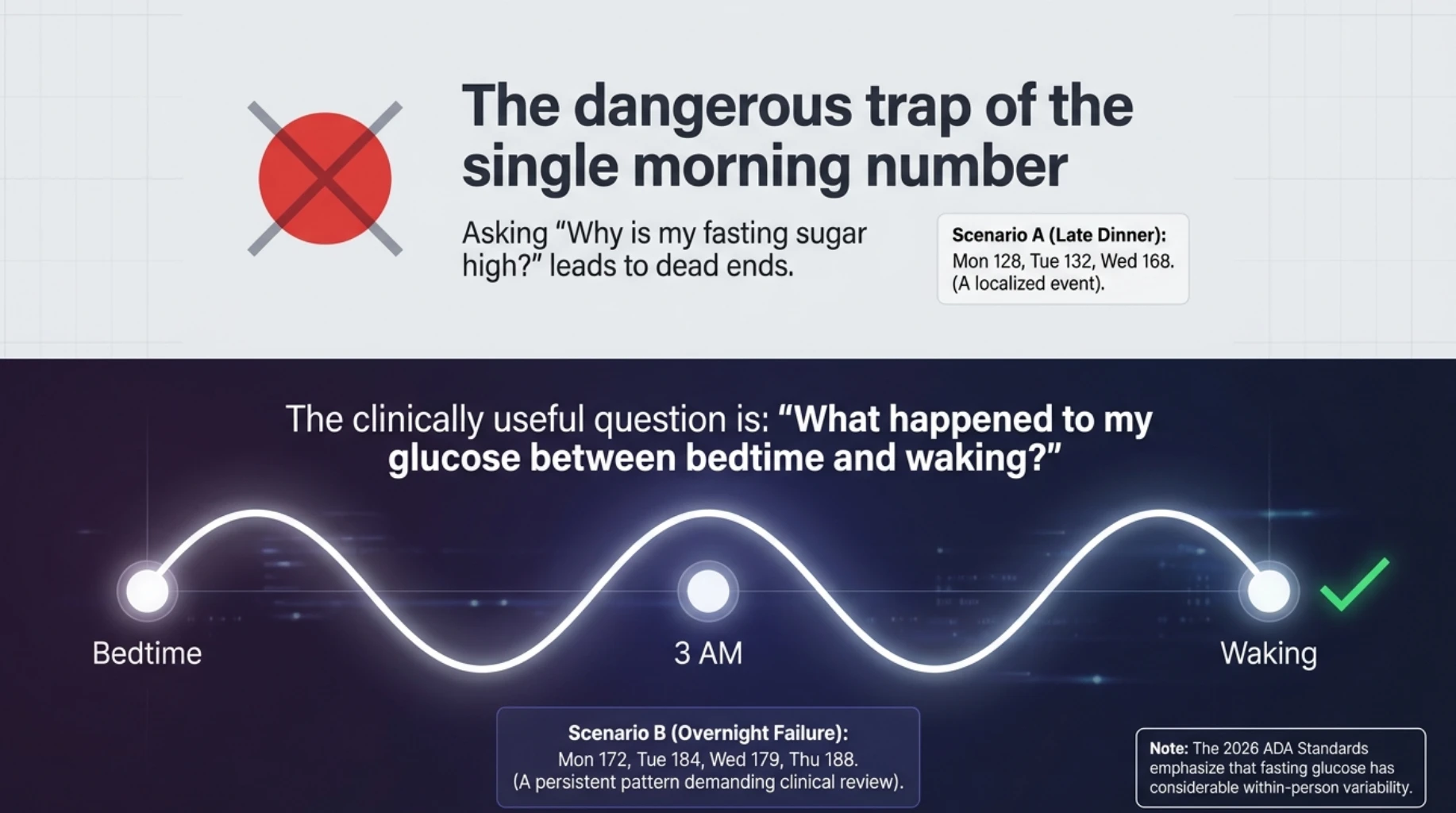
The useful question is therefore not simply:
“Why is my fasting sugar high?”
It is:
“What happened to my glucose between bedtime and waking?”
That distinction is important because different overnight patterns may require very different responses.
Why Is Blood Sugar High in the Morning?
Common reasons for high glucose after waking include:
- the dawn phenomenon
- insufficient overnight insulin
- diabetes medicine wearing off before morning
- glucose already being high at bedtime
- a late carbohydrate-heavy meal or snack
- illness or physiological stress
- changes in overall diabetes control
The American Diabetes Association identifies the dawn phenomenon and waning insulin as two major causes of morning highs. It also describes rebound after overnight hypoglycemia—the traditional Somogyi effect—as a much rarer possibility.
Looking at bedtime, overnight and waking glucose values can often reveal which pattern is occurring.
Do not increase insulin simply because one morning value is high. If glucose falls too low earlier in the night, increasing overnight insulin could worsen hypoglycemia.
What Counts as Morning High Blood Sugar?
There is no one glucose number that is appropriate for every person with diabetes.
For many nonpregnant adults, the 2026 American Diabetes Association Standards list a premeal glucose target of 80–130 mg/dL and an HbA1c target below 7%, but goals should be individualized according to age, comorbidities, hypoglycemia risk, treatment burden and other clinical factors.
Therefore, a morning glucose of 145 mg/dL may be above the usual target for one person, while a different target may have deliberately been chosen for another.
The trend matters more than one number.
For example:
Monday: 128 mg/dL
Tuesday: 132 mg/dL
Wednesday: 168 mg/dL after a late dinner
is different from:
Monday: 172 mg/dL
Tuesday: 184 mg/dL
Wednesday: 179 mg/dL
Thursday: 188 mg/dL
The second pattern suggests that the overnight glucose problem is persistent and deserves review.
One High Morning Reading Does Not Tell the Whole Story
Home glucose readings naturally vary.
Food, physical activity, illness, acute stress, alcohol, medication timing and normal biological variation can all influence glucose. The 2026 ADA Standards note that fasting glucose has considerable within-person variability and can be affected by recent illness, stress and activity.
Before concluding that treatment has stopped working, look for a pattern across several days.
It is also worth checking whether:
- hands were washed before testing
- strips were stored correctly
- the meter is functioning normally
- the measurement was genuinely fasting
- a late-night snack or drink contained carbohydrate
If the result seems very different from your usual pattern, repeating the test can sometimes help rule out a measurement problem.
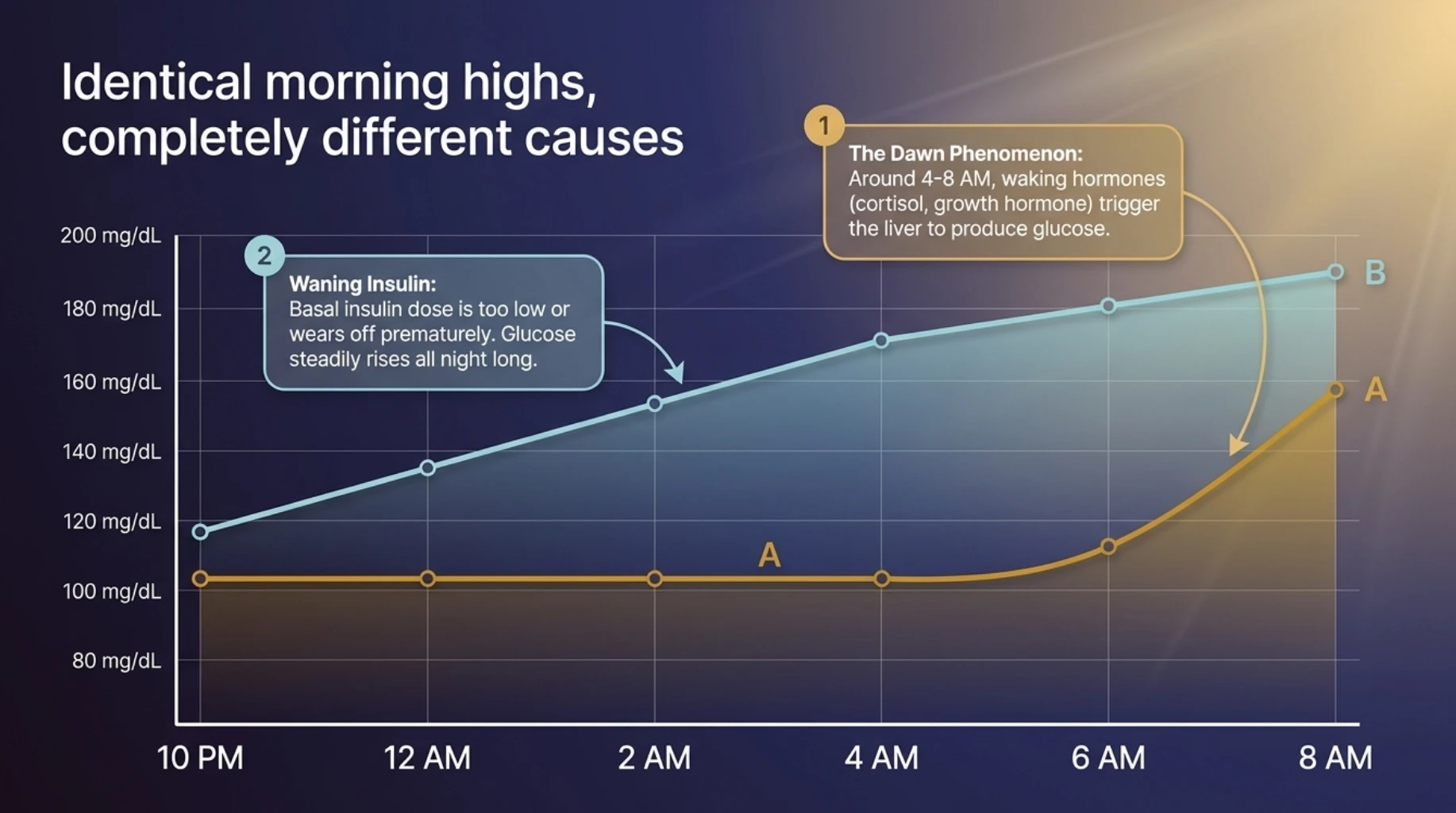
Cause 1: The Dawn Phenomenon
The dawn phenomenon is one of the best-known causes of high morning glucose.
During the early hours of the morning, the body releases hormones involved in preparing you to wake up. These include cortisol, growth hormone, glucagon and adrenaline-related hormones.
These hormones can increase glucose production by the liver and temporarily reduce insulin sensitivity.
In someone without diabetes, the pancreas usually produces enough insulin to compensate.
In someone with diabetes, insulin production may be insufficient or the body may be resistant to insulin, allowing glucose to rise before waking.
Mayo Clinic describes the dawn phenomenon as an early-morning glucose rise typically occurring around 4 a.m. to 8 a.m.
The ADA similarly describes an early-morning hormone-driven rise in liver glucose production that may not be fully offset by insulin in people with either type 1 or type 2 diabetes.
Morning High Blood Sugar and the Dawn Phenomenon
A typical dawn-phenomenon pattern might look like this:
Bedtime: 112 mg/dL
2–3 a.m.: 105 mg/dL
6–7 a.m.: 158 mg/dL
The important clue is that glucose was not high at bedtime and did not become dangerously low overnight. It simply began rising during the early morning.
A CGM can make this pattern easier to see because it records glucose through the night.
Without a CGM, your clinician may sometimes suggest checking glucose around 2–3 a.m. for several nights when trying to distinguish the dawn phenomenon from other causes. Both Mayo Clinic and the ADA recommend overnight readings or CGM data when frequent morning highs need explanation.
Do not automatically assume every high fasting reading is the dawn phenomenon.
If glucose was already high before sleep, the problem may have started much earlier.
Cause 2: Overnight Insulin or Diabetes Medicine Is Not Lasting Long Enough
Another common explanation is waning insulin.
If the amount of insulin available overnight becomes insufficient, glucose can gradually rise before morning.
This may occur when:
- a basal insulin dose is too low
- the timing does not adequately cover the full night
- an insulin pump’s overnight basal rate is insufficient
- a dose was forgotten or taken incorrectly
- another diabetes treatment is no longer providing enough glucose control
The ADA identifies waning insulin as one of the two main explanations for recurrent morning highs. In people using long-acting insulin, the medicine’s duration and timing can influence whether enough insulin remains active into the early morning.
This issue is particularly important because the solution is not always simply more insulin.
The overnight pattern needs to be understood first.
A Normal Bedtime Reading Can Still Become High by Morning
Consider:
Bedtime: 118 mg/dL
2 a.m.: 140 mg/dL
5 a.m.: 172 mg/dL
Waking: 190 mg/dL
This pattern looks different from a sharp early-morning rise after stable overnight readings.
Medication timing, duration and dose may deserve review.
If you use insulin, bring the exact:
- insulin name
- dose
- injection time
- recent dose changes
- missed doses
- CGM or glucose readings
Do not describe treatment only as:
“I take 20 units at night.”
Different basal insulins have different pharmacological profiles, and the actual product matters.
Similarly, do not change the timing or increase the dose on your own because the correct response depends on whether glucose is high throughout the night, rises only near morning, or falls too low before rising again.
Cause 3: Dinner or a Bedtime Snack Is Keeping Glucose High Overnight
Sometimes morning high blood sugar begins the evening before.
A large dinner or carbohydrate-containing bedtime snack can keep glucose elevated for hours.
This becomes more likely when:
Bedtime glucose is already high → overnight glucose stays high → morning glucose remains high.
The ADA specifically notes that if glucose is elevated at bedtime, contributors may include food intake or insufficient medication with the evening meal. A carbohydrate-containing bedtime snack can also contribute to elevated morning glucose.
The important point is not that everyone with diabetes must avoid carbohydrates at dinner.
Instead, look at:
- portion size
- meal timing
- total carbohydrate
- sugary drinks
- dessert
- alcohol
- bedtime snacks
- whether evening medication or mealtime insulin was taken as prescribed
For example, a person whose glucose is 210 mg/dL before bed and 185 mg/dL on waking does not have the same pattern as someone who goes to bed at 110 mg/dL and wakes at 180 mg/dL.
The first problem may be more closely related to the evening meal or treatment of that meal.
The second requires closer examination of what happened overnight.
Cause 4: Overnight Low Blood Sugar and the Somogyi Effect
The Somogyi effect is the idea that glucose may fall too low overnight and then rebound upward as the body releases counter-regulatory hormones.
It is often mentioned when discussing high morning glucose.
However, current ADA patient guidance describes this as a much rarer cause of morning highs than either the dawn phenomenon or insufficient overnight insulin.
This distinction matters because assuming that every high morning reading reflects overnight hypoglycemia can lead to inappropriate treatment changes.
The only reliable way to determine whether a nighttime low occurred is to measure what actually happened.
A possible rebound pattern might show:
Bedtime: 125 mg/dL
2–3 a.m.: 58 mg/dL
Waking: 175 mg/dL
By contrast, if glucose is 145 mg/dL at 2 a.m. and 185 mg/dL on waking, overnight hypoglycemia is clearly not the explanation.
Why You Should Confirm Overnight Glucose Before Increasing Insulin
This is one of the most important practical points.
If glucose is high every morning, it may be tempting to increase nighttime insulin.
But if glucose is already dropping too low earlier in the night, a larger dose could create more severe hypoglycemia.
The ADA recommends collecting glucose data at bedtime, during the night and on waking when recurrent morning highs need explanation. CGM can provide the same information without requiring repeated overnight finger-stick testing.
This is why medication adjustment should follow the pattern, not one fasting number.
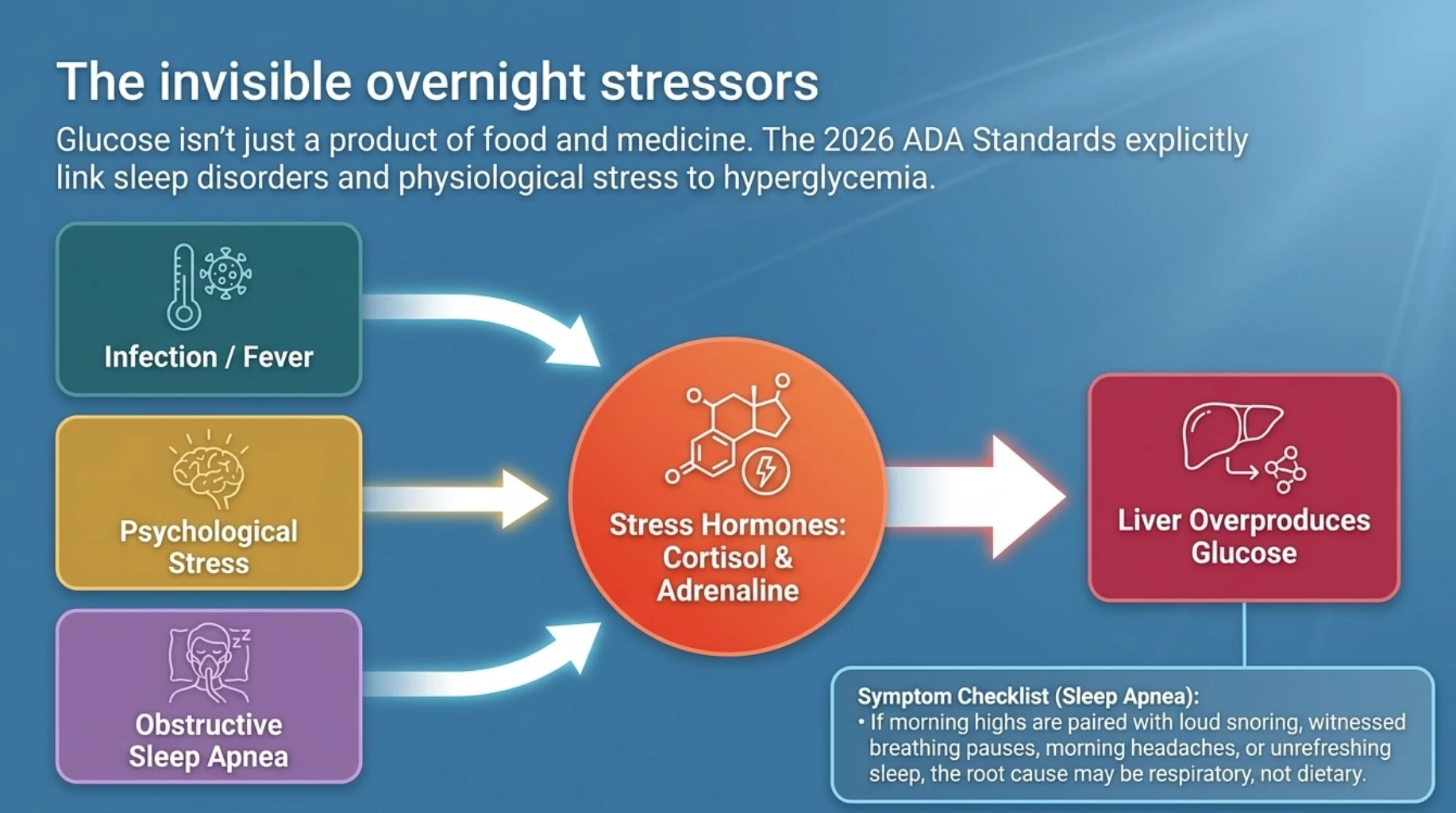
Cause 5: Illness, Stress or Another Temporary Change Is Raising Glucose
Glucose often rises during illness.
The body releases stress hormones to help respond to infection or other physiological stress. These hormones can increase liver glucose production and make insulin less effective.
The ADA lists illness and psychological stress among recognized causes of hyperglycemia.
Morning readings may therefore become temporarily higher during:
- respiratory infection
- fever
- urinary infection
- significant inflammation
- surgery or injury
- severe emotional stress
A temporary increase during an illness does not necessarily mean the long-term diabetes regimen has permanently failed.
Look at the timeline.
If fasting glucose was previously around 110–125 mg/dL and becomes 160–180 mg/dL during a significant infection, illness may be contributing.
Once recovery occurs, glucose may fall again.
People with type 1 diabetes or insulin-treated diabetes may need a specific sick-day plan because insulin requirements can change during illness and ketones can become clinically important.
Do not stop insulin simply because you are eating less during an illness unless your treating clinician has specifically instructed you how to adjust it.
Cause 6: Poor Sleep or Obstructive Sleep Apnea
Sleep can influence glucose regulation.
Short, fragmented or irregular sleep may worsen insulin sensitivity and make diabetes management more difficult. Sleep disorders are also common among people with diabetes.
The 2026 ADA Standards recommend screening people with prediabetes or diabetes for sleep health, including possible sleep disorders and sleep disruption related to diabetes.
One condition worth considering is obstructive sleep apnea, particularly when morning glucose problems occur alongside:
- loud snoring
- witnessed pauses in breathing
- waking gasping or choking
- morning headache
- unrefreshing sleep
- excessive daytime sleepiness
- resistant hypertension
This does not mean sleep apnea is responsible every time fasting glucose rises.
However, repeatedly poor sleep may be one part of the metabolic picture, especially when someone has type 2 diabetes, abdominal obesity or significant daytime sleepiness.
Improving sleep should therefore be viewed as part of diabetes care rather than an unrelated lifestyle issue.
If you regularly sleep for only five or six hours, wake frequently or snore heavily, mention it during the consultation rather than focusing exclusively on the glucose meter.
Cause 7: Diabetes Has Changed and Treatment May Need Review
Sometimes there is no single overnight trigger.
The morning readings may be showing that overall diabetes control has changed.
Type 2 diabetes can evolve over time. Insulin resistance may remain significant while the pancreas gradually becomes less able to produce enough insulin to maintain previous glucose levels.
Other changes can also alter treatment needs:
- weight change
- reduced physical activity
- steroid treatment
- another new medicine
- kidney-function changes
- illness
- inconsistent medication use
- changes in food intake
This does not mean someone has “failed” their diabetes treatment.
It means the current treatment plan may no longer match the current physiology.
Repeated fasting highs should therefore be interpreted alongside:
- HbA1c
- daytime glucose readings
- post-meal glucose
- CGM data when available
- medication adherence
- kidney function
- hypoglycemia history
The 2026 ADA Standards emphasize individualizing glucose-lowering treatment and avoiding therapeutic inertia when glycemic goals are not being met. They also recommend reassessing for signs of overbasalisation in insulin-treated patients, including excessive bedtime-to-morning glucose differences, hypoglycemia and high glucose variability.
The aim is not simply to force the morning number down. It is to improve the overall glucose pattern while avoiding overnight hypoglycemia.
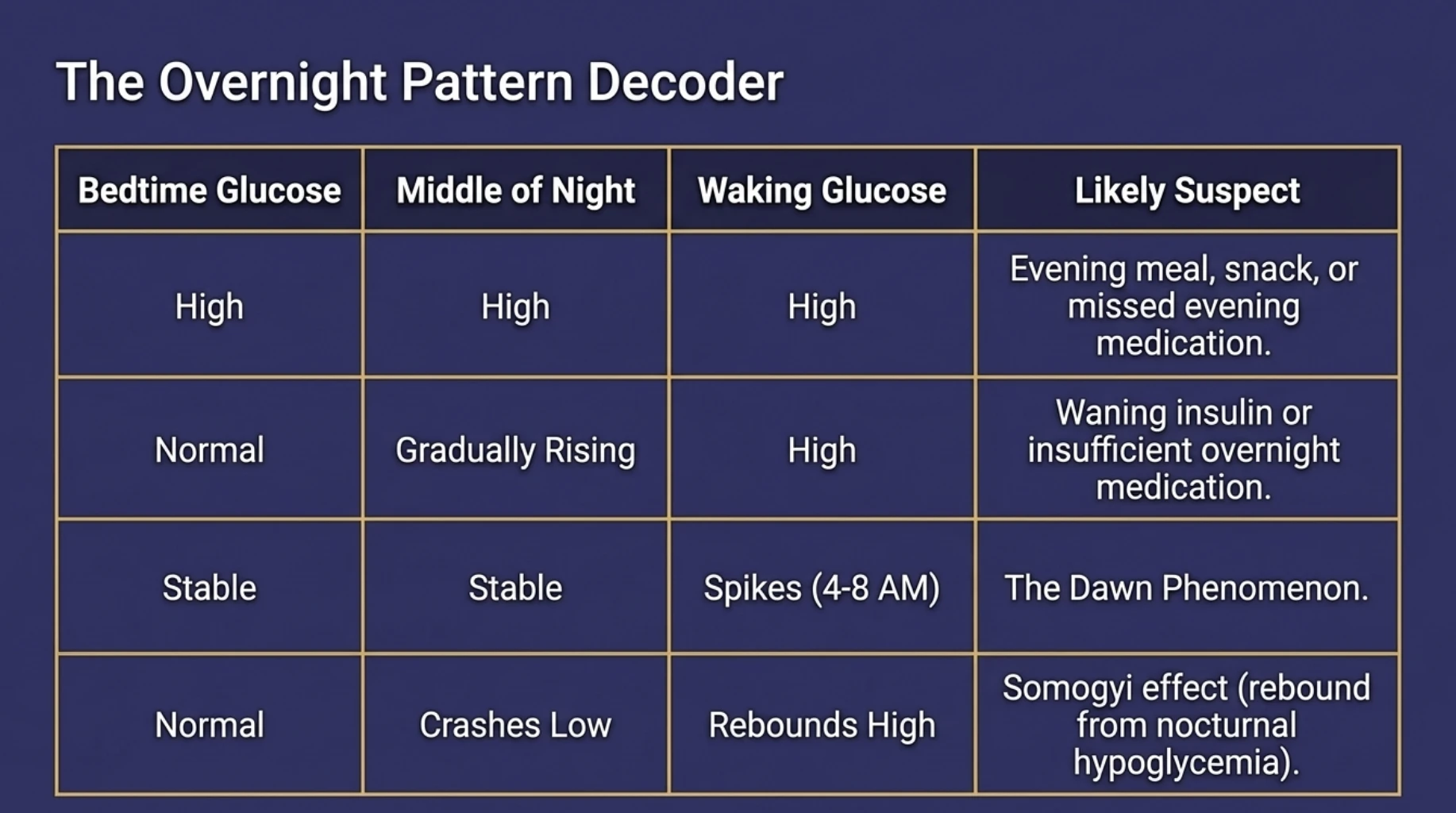
How Bedtime, Overnight and Morning Readings Help Find the Cause
Three time points can sometimes tell a remarkably useful story:
bedtime → middle of the night → waking
For example:
| Glucose pattern | What it may suggest |
|---|---|
| High at bedtime and still high in the morning | Evening meal, snack or insufficient evening treatment |
| Normal at bedtime, gradually rising through the night | Insufficient overnight medication or basal insulin |
| Stable overnight, then rising around 3–8 a.m. | Dawn phenomenon |
| Low overnight followed by high morning glucose | Possible rebound after nocturnal hypoglycemia |
| Variable highs and lows throughout the night | Treatment, meal, activity or insulin-pattern issues needing closer review |
These patterns are examples rather than diagnostic rules.
The ADA recommends checking glucose at bedtime, during the night and first thing in the morning when recurrent morning highs need explanation. A CGM can capture the same pattern continuously.
A few days of structured readings are usually more informative than bringing twenty unrelated glucose values with no information about when they were measured.
What Should You Discuss With Your Doctor?
When morning glucose is repeatedly high, useful questions include:
- Is this likely to be the dawn phenomenon?
- Is my glucose already high before bed?
- Could my evening meal or snack be contributing?
- Is my diabetes medicine lasting through the night?
- Do I need overnight glucose readings?
- Could I be having unnoticed hypoglycemia?
- Does my HbA1c support the home readings?
- Could another medicine be raising my glucose?
- Should my insulin timing or type be reviewed?
- Would CGM help clarify the pattern?
- Are my sleep habits or possible sleep apnea relevant?
Bring the exact names and doses of your medicines.
If you use insulin, also note:
- injection time
- insulin name
- dose
- missed doses
- recent dose changes
- any nighttime low-glucose symptoms
This information makes medication decisions considerably safer.
Bring Glucose or CGM Patterns, Not Just One Reading
The 2026 ADA Standards recommend glucose monitoring according to the person’s treatment and circumstances. For people using insulin, useful times can include fasting, before meals, after meals, at bedtime, during the night and when hypoglycemia or hyperglycemia is suspected.
A practical three- to seven-day record might include:
- dinner time
- bedtime glucose
- bedtime snack if any
- nighttime reading when specifically advised
- waking glucose
- insulin or medicine timing
- exercise
- unusual illness or stress
CGM can simplify this considerably.
The ADA’s 2026 pharmacological standards recommend CGM for adults using insulin and in several other situations where continuous glucose information aids management.
The purpose is not to generate more numbers.
It is to identify when glucose begins to rise.
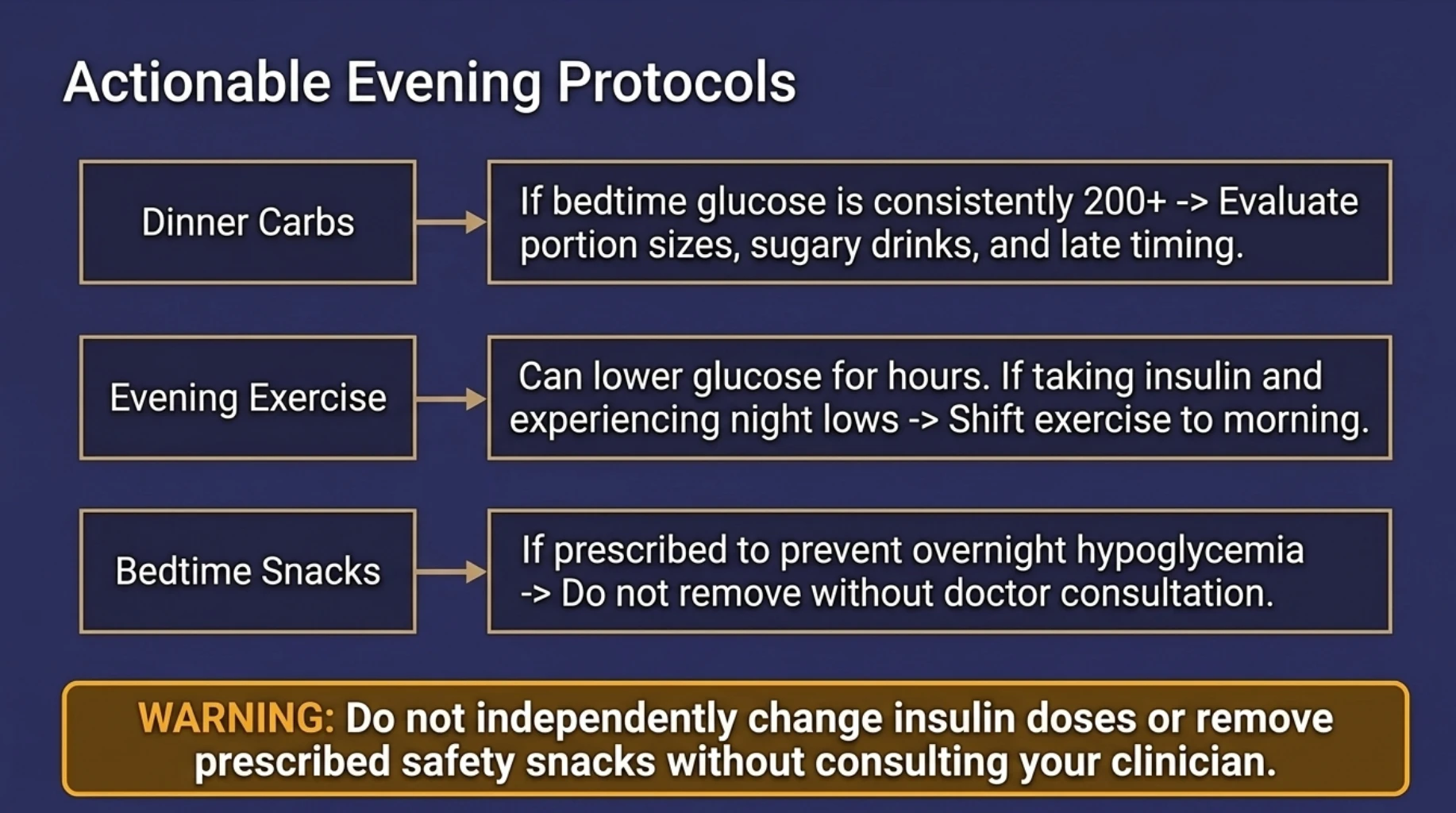
Should You Change Dinner or Bedtime Snacks?
Possibly—but only if the glucose pattern supports it.
If glucose is already high at bedtime, dinner composition, portion size or a late snack may be contributing.
The ADA notes that a large dinner or bedtime snack can produce glucose elevations that persist into the morning.
Useful questions include:
- Is dinner very late?
- Is there a large portion of rice, roti or another carbohydrate?
- Is dessert frequent?
- Are sugary beverages involved?
- Is a bedtime snack actually necessary?
- Is evening insulin or medication being taken correctly?
The answer is not necessarily to eliminate carbohydrates completely.
Instead, meal timing, portion size and treatment need to be considered together.
Someone taking insulin or a sulfonylurea may also have different bedtime-snack needs from someone taking medicines with very low hypoglycemia risk.
Do not remove a snack that was specifically recommended to prevent overnight hypoglycemia without discussing the reason it was prescribed.
Should You Exercise in the Evening?
Physical activity can improve glucose control, and an after-dinner walk may help reduce evening and overnight glucose in some people.
The ADA notes that exercise after dinner may help when waning insulin or high evening glucose is contributing to morning highs. However, exercise can lower glucose for hours afterwards and may increase the risk of nocturnal hypoglycemia in susceptible people.
That risk is particularly relevant for people using:
- insulin
- sulfonylureas
- other treatments associated with hypoglycemia
If evening exercise repeatedly leads to overnight lows, morning or earlier daytime activity may be safer.
The correct timing depends on the glucose pattern and treatment.
Exercise should therefore be part of the discussion—not used as a universal prescription to “burn off” morning glucose.
Should You Change Diabetes Medicine or Insulin Timing?
Not on the basis of one high fasting reading.
Possible treatment changes depend on what the overnight glucose pattern shows.
If glucose is:
high before bed
the evening meal or mealtime treatment may need attention.
normal at bedtime but steadily rising overnight
medication duration or basal insulin may need review.
stable until the early morning and then rises
the dawn phenomenon may be contributing.
falling too low overnight
increasing insulin could be unsafe.
ADA guidance specifically warns that simply increasing long-acting insulin for dawn-related morning highs can cause excessive glucose lowering earlier in the night.
Similarly, the 2026 Standards recommend reassessing insulin therapy when there is significant bedtime-to-morning variation or hypoglycemia rather than continuously escalating basal insulin.
Do not independently:
- double a diabetes tablet
- increase basal insulin
- change insulin timing
- stop insulin
- add an extra correction dose every morning
Treatment changes should reflect the full glucose pattern.
When Morning High Blood Sugar Needs Prompt Medical Attention
Most moderately elevated fasting readings can be discussed in a routine diabetes review.
Very high glucose accompanied by illness or symptoms is different.
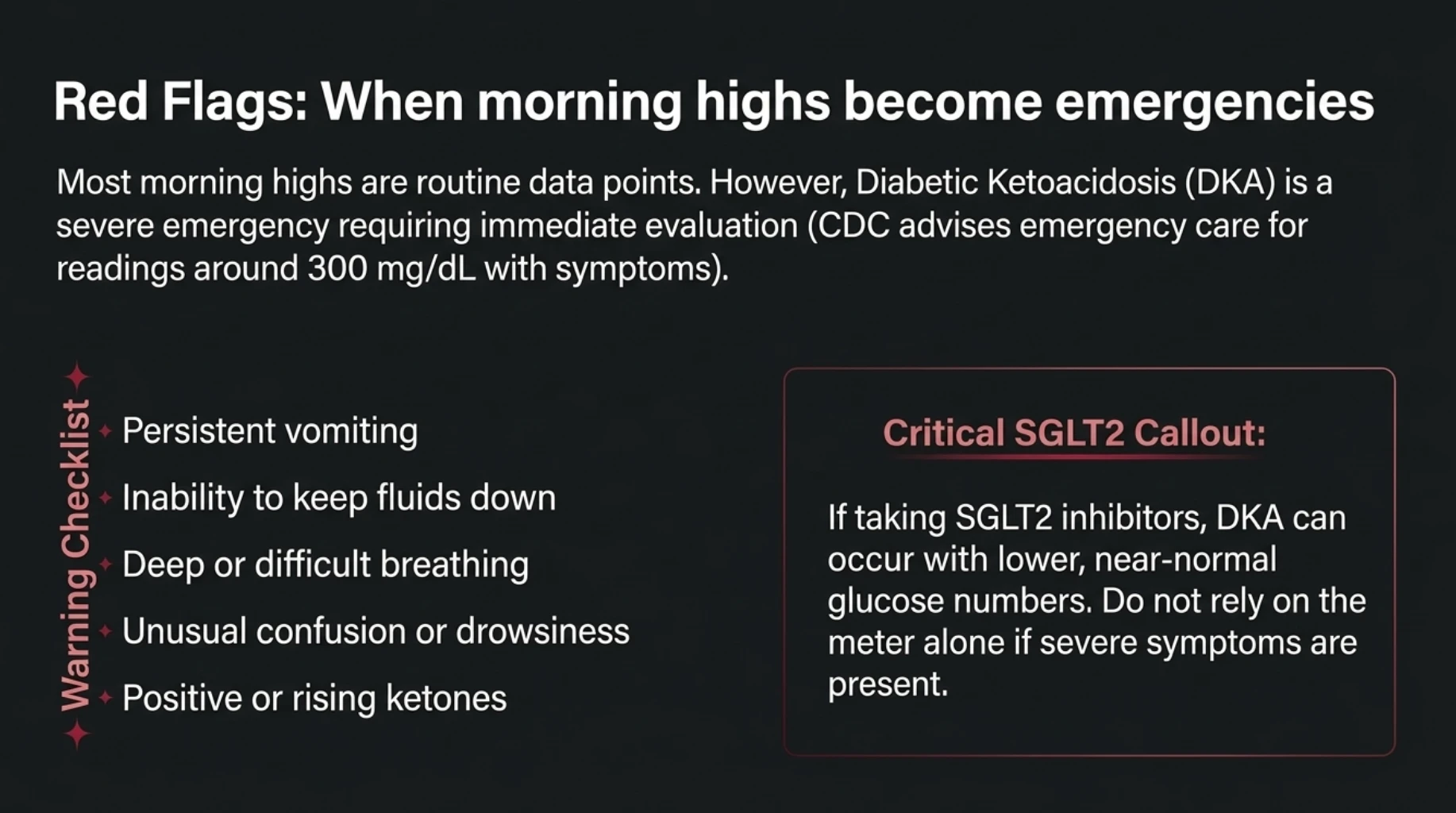
Seek prompt medical advice when high glucose occurs with:
- persistent vomiting
- inability to keep fluids down
- abdominal pain
- increasing thirst and urination
- significant dehydration
- unusual drowsiness
- confusion
- deep or difficult breathing
- positive or rising ketones
Diabetic ketoacidosis, or DKA, is a serious hyperglycemic emergency. It is most common in type 1 diabetes but can also occur in type 2 diabetes. The 2026 ADA Standards recommend ketone monitoring for people at risk when illness, missed insulin or other precipitating factors are present, particularly when glucose exceeds about 200 mg/dL.
CDC guidance advises emergency evaluation when glucose remains around 300 mg/dL or higher, or when symptoms such as vomiting, inability to keep fluids down, breathing difficulty or multiple features of DKA occur.
One important exception is people using SGLT2 inhibitors. DKA can occasionally occur with glucose that is not dramatically elevated, so nausea, vomiting, abdominal pain, dehydration or breathing abnormalities may require ketone assessment even when the meter does not show an extreme number.
Follow your individual sick-day plan if you have one.
What if You Do Not Already Have Diabetes?
Repeated high fasting glucose deserves laboratory evaluation even if diabetes has never been diagnosed.
For nonpregnant adults, the 2026 ADA criteria define:
- prediabetes: fasting plasma glucose 100–125 mg/dL
- diabetes: fasting plasma glucose ≥126 mg/dL
- prediabetes: HbA1c 5.7–6.4%
- diabetes: HbA1c ≥6.5%
A two-hour glucose during a 75-g oral glucose tolerance test of 140–199 mg/dL is in the prediabetes range, while ≥200 mg/dL is in the diabetes range.
These criteria refer to proper laboratory testing, not simply one home glucometer reading.
In the absence of unequivocal hyperglycemia, the ADA requires confirmation with another abnormal result.
Do not diagnose yourself from a single morning finger-stick measurement.
Arrange testing if morning glucose is repeatedly elevated, particularly when there are symptoms such as:
- increased thirst
- frequent urination
- unexplained weight loss
- blurred vision
- recurrent infections
Morning Blood Sugar Review at Diet Plus Minus in Dwarka
Repeated morning glucose elevations can be reviewed as part of diabetes care.
Dr. Pankaj Kumar can review:
- fasting glucose trends
- bedtime and overnight readings
- HbA1c
- CGM reports
- dinner and snack timing
- diabetes medicines
- insulin type, dose and timing
- episodes of hypoglycemia
- illness or steroid exposure
- sleep and possible sleep-apnea symptoms
- kidney function and other relevant reports
- whether treatment modification or further evaluation is appropriate
Bring your glucose meter, written log or CGM report if available.
Also bring the actual medicine strips, prescription or insulin details rather than relying on memory.
Dr. Pankaj Kumar
MBBS, DNB Family Medicine, Sir Ganga Ram Hospital
General & Lifestyle Physician
Special interest in Diabetes
Diet Plus Minus
13A, Pocket-2, Sector-6, Doctors Lane
Dwarka, New Delhi – 110075
India
Book an Appointment with Dr. Pankaj Kumar
Frequently Asked Questions
Why Is My Blood Sugar High in the Morning if I Did Not Eat Overnight?
Your liver continues releasing glucose while you sleep.
Early-morning hormones can increase liver glucose production, and if insulin is insufficient or insulin resistance is present, glucose may rise before waking. This is known as the dawn phenomenon.
What Is the Dawn Phenomenon?
The dawn phenomenon is an early-morning glucose rise associated with hormonal changes before waking.
The ADA describes it as typically occurring in the early morning, while Mayo Clinic places the commonly recognized period at approximately 4–8 a.m.
Is the Dawn Phenomenon Only Seen in Type 1 Diabetes?
No.
It can occur in both type 1 and type 2 diabetes.
Is Morning Blood Sugar More Important Than HbA1c?
They answer different questions.
Morning glucose shows one part of the daily pattern. HbA1c reflects average glycemic exposure over the preceding months.
A person can have acceptable fasting glucose but high post-meal readings, or high fasting glucose with otherwise reasonable daytime control.
Both may be useful.
Is 130 mg/dL High for Fasting Blood Sugar?
For many nonpregnant adults who already have diabetes, the ADA’s usual premeal target is 80–130 mg/dL, although individual targets can differ.
For someone without diagnosed diabetes, diagnostic thresholds are different and should be assessed using laboratory testing.
Does a Fasting Sugar of 126 mg/dL Mean I Have Diabetes?
A laboratory fasting plasma glucose of 126 mg/dL or higher meets a diagnostic threshold for diabetes.
However, in the absence of unequivocal hyperglycemia, ADA guidelines require confirmatory testing.
One home glucose-meter reading does not establish the diagnosis.
Can Eating Late at Night Raise Morning Blood Sugar?
Yes.
A late dinner or carbohydrate-containing bedtime snack can keep glucose elevated overnight, especially when glucose is already high before sleep.
The meal pattern should be evaluated together with medication timing.
Should I Stop Eating Carbohydrates at Dinner?
Not automatically.
The type and amount of carbohydrate, overall meal composition, glucose pattern and diabetes treatment all matter.
Completely eliminating carbohydrates is not necessary for everyone with morning highs.
Can Poor Sleep Raise Morning Glucose?
Poor sleep and sleep disorders are associated with adverse metabolic health and can complicate diabetes management.
The 2026 ADA Standards recommend screening people with diabetes and prediabetes for sleep health and sleep disorders.
Can Sleep Apnea Affect Diabetes Control?
It can be part of the metabolic picture.
Obstructive sleep apnea is common among people with diabetes and can coexist with obesity, hypertension and disrupted sleep. Loud snoring, witnessed pauses in breathing and excessive daytime sleepiness should be discussed with your clinician.
Should I Check My Sugar at 3 a.m.?
Not everyone needs to.
When recurrent morning highs are unexplained, a clinician may recommend bedtime, overnight and waking measurements for several nights. A CGM can often provide this information more conveniently.
Is the Somogyi Effect Common?
Current ADA patient guidance describes rebound following overnight hypoglycemia as a much rarer explanation for morning highs than the dawn phenomenon or waning insulin.
The glucose pattern should be measured rather than assumed.
Should I Increase My Night Insulin if Morning Sugar Is High?
Not without understanding what happens overnight.
If glucose becomes too low during the night, increasing basal insulin could worsen hypoglycemia. Treatment changes should be made using bedtime, overnight and morning patterns together.
Can Stress Increase Morning Blood Sugar?
Yes.
Physical or psychological stress can raise glucose by increasing counter-regulatory hormones. Illness can have a similar effect.
When Is High Morning Sugar Dangerous?
A moderately elevated fasting reading is usually not an emergency by itself.
Urgent assessment is needed when severe hyperglycemia is accompanied by vomiting, significant dehydration, abdominal pain, breathing difficulty, confusion or elevated ketones.
Author Box
Dr. Pankaj Kumar
MBBS, DNB Family Medicine, Sir Ganga Ram Hospital
General & Lifestyle Physician
Special interest in Diabetes
Dr. Pankaj Kumar provides general medical and lifestyle-based care at Diet Plus Minus in Dwarka, New Delhi, with a special interest in diabetes. His approach includes review of fasting and overnight glucose patterns, HbA1c, diabetes medicines, insulin use, lifestyle factors and associated metabolic-health concerns, with specialist referral when appropriate.
Medical Disclaimer
This article provides general educational information and does not replace an individual medical consultation, diagnosis or treatment plan.
Do not start, stop, increase, reduce or change the timing of insulin or other prescription diabetes medicines solely because of one morning glucose value.
People at risk of diabetic ketoacidosis should follow their individual sick-day and ketone-monitoring instructions.
Seek urgent medical attention for high glucose accompanied by persistent vomiting, inability to maintain hydration, abdominal pain, deep or difficult breathing, confusion, significant ketones or another rapid clinical deterioration.
References
- American Diabetes Association. High Morning Blood Glucose: Understanding and Management. Current ADA patient guidance. Explains the dawn phenomenon, waning insulin, the less common Somogyi effect and the value of bedtime, overnight and waking glucose measurements.
- American Diabetes Association Professional Practice Committee for Diabetes. Glycemic Goals, Hypoglycemia, and Hyperglycemic Crises: Standards of Care in Diabetes—2026. Diabetes Care. 2026;49(Suppl 1):S132–S149. Covers individualized glucose targets, hypoglycemia, sick-day management and hyperglycemic crises.
- American Diabetes Association Professional Practice Committee for Diabetes. Diabetes Technology: Standards of Care in Diabetes—2026. Diabetes Care. 2026;49(Suppl 1):S150 onward. Provides current recommendations on blood glucose monitoring and CGM.
- American Diabetes Association Professional Practice Committee for Diabetes. Pharmacologic Approaches to Glycemic Treatment: Standards of Care in Diabetes—2026. Diabetes Care. 2026;49(Suppl 1):S183–S215. Includes recommendations on CGM, insulin treatment and assessment for overbasalisation.
- American Diabetes Association Professional Practice Committee for Diabetes. Facilitating Positive Health Behaviors and Well-being to Improve Health Outcomes: Standards of Care in Diabetes—2026. Diabetes Care. 2026;49(Suppl 1). Recommends sleep-health and sleep-disorder screening in people with diabetes or prediabetes.
- American Diabetes Association Professional Practice Committee for Diabetes. Diagnosis and Classification of Diabetes: Standards of Care in Diabetes—2026. Diabetes Care. 2026;49(Suppl 1):S27–S49. Provides current fasting glucose, HbA1c and OGTT thresholds for prediabetes and diabetes and requirements for confirmatory testing.
- Centers for Disease Control and Prevention. Diabetic Ketoacidosis. Current CDC patient guidance. Reviews DKA symptoms, ketone testing and circumstances requiring emergency medical care.

Written by Dr. Pankaj Kumar
General & Lifestyle Physician in Dwarka Sector 6, New Delhi · MBBS, DNB (Family Medicine), DNHE · 16 years of experience.
About the doctor →Book a consultation → Beyond Blood Sugar
 The 90-Day Prediabetes Turnaround
 The Indian Diabetes Diet Reset
 Eat to Beat Gout
 Why Is My Hair Falling?
 The 30-Day Inflammation Reset