Waking with a headache once after a poor night’s sleep may not mean much. Repeated morning headaches, however, deserve a closer look—especially if they are becoming more frequent, affecting daily function or occurring with snoring, jaw pain, nausea, daytime sleepiness or frequent painkiller use.
The timing alone does not identify the cause.
A headache that is already present when you open your eyes can occur with obstructive sleep apnea, teeth grinding, migraine, disturbed sleep, caffeine withdrawal or medication-overuse headache. Less common but important medical problems can also present with headache on waking.
The International Classification of Headache Disorders specifically recognizes a headache associated with sleep apnea, but also emphasizes that headache on awakening is nonspecific and can occur in several primary and secondary headache disorders.
The useful question is therefore not simply: “Why does my head hurt in the morning?” It is: “What other clues occur with the headache, and what pattern has developed over time?”
Why Do Morning Headaches Happen?
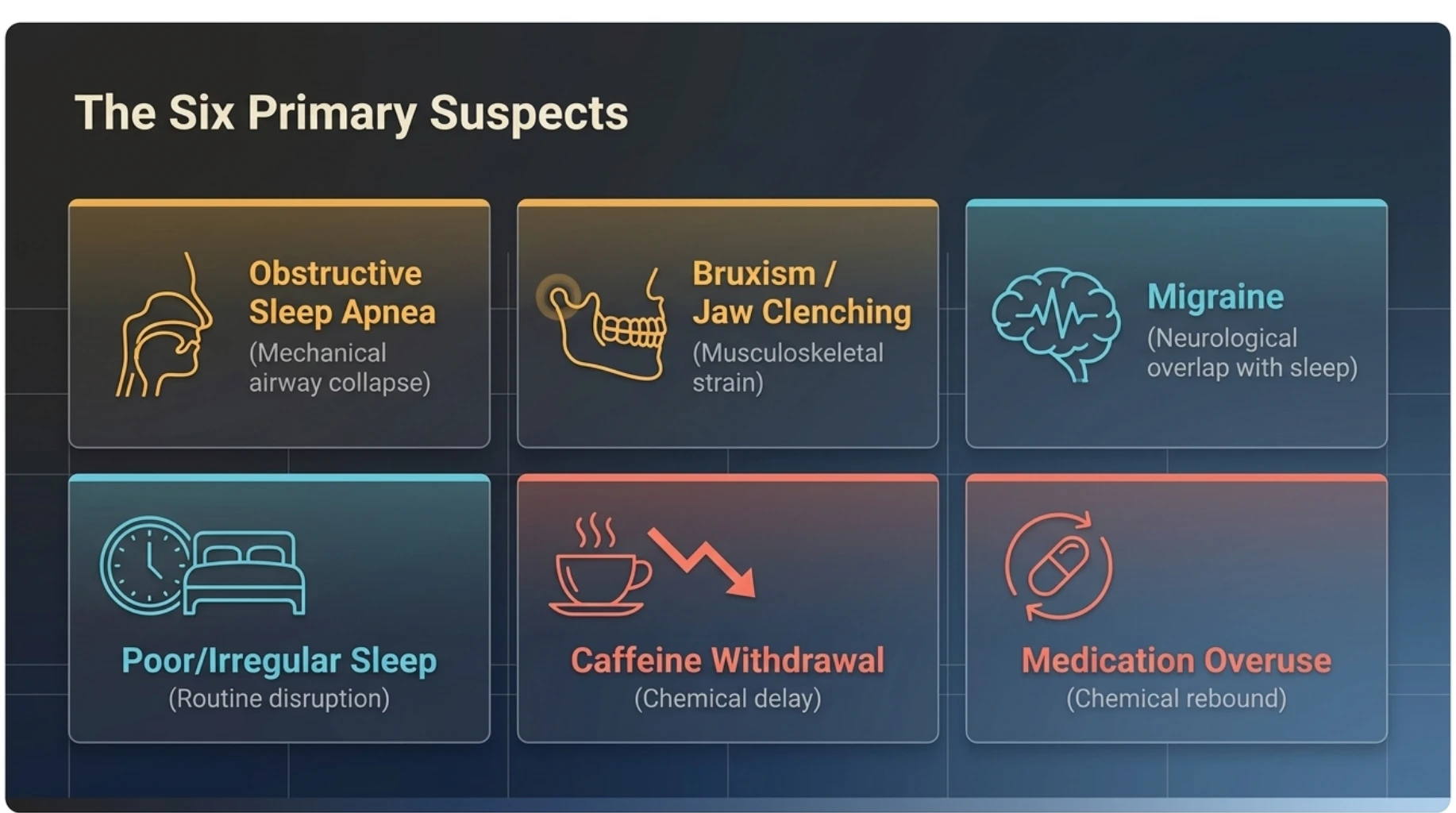
Six possible explanations are:
- obstructive sleep apnea
- teeth grinding or jaw clenching during sleep
- migraine
- poor-quality, insufficient or irregular sleep
- overnight caffeine withdrawal
- medication-overuse headache
These causes are not equally likely in every person.
For example, loud snoring and excessive daytime sleepiness make sleep apnea more relevant. Jaw stiffness and worn teeth point more toward bruxism. Throbbing pain with nausea or sensitivity to light and sound makes migraine more plausible.
Repeated headaches also deserve attention because the National Institute of Neurological Disorders and Stroke advises medical review when headaches are becoming more frequent, worsening over time or changing significantly in pattern.
What Does a Headache on Waking Actually Tell You?
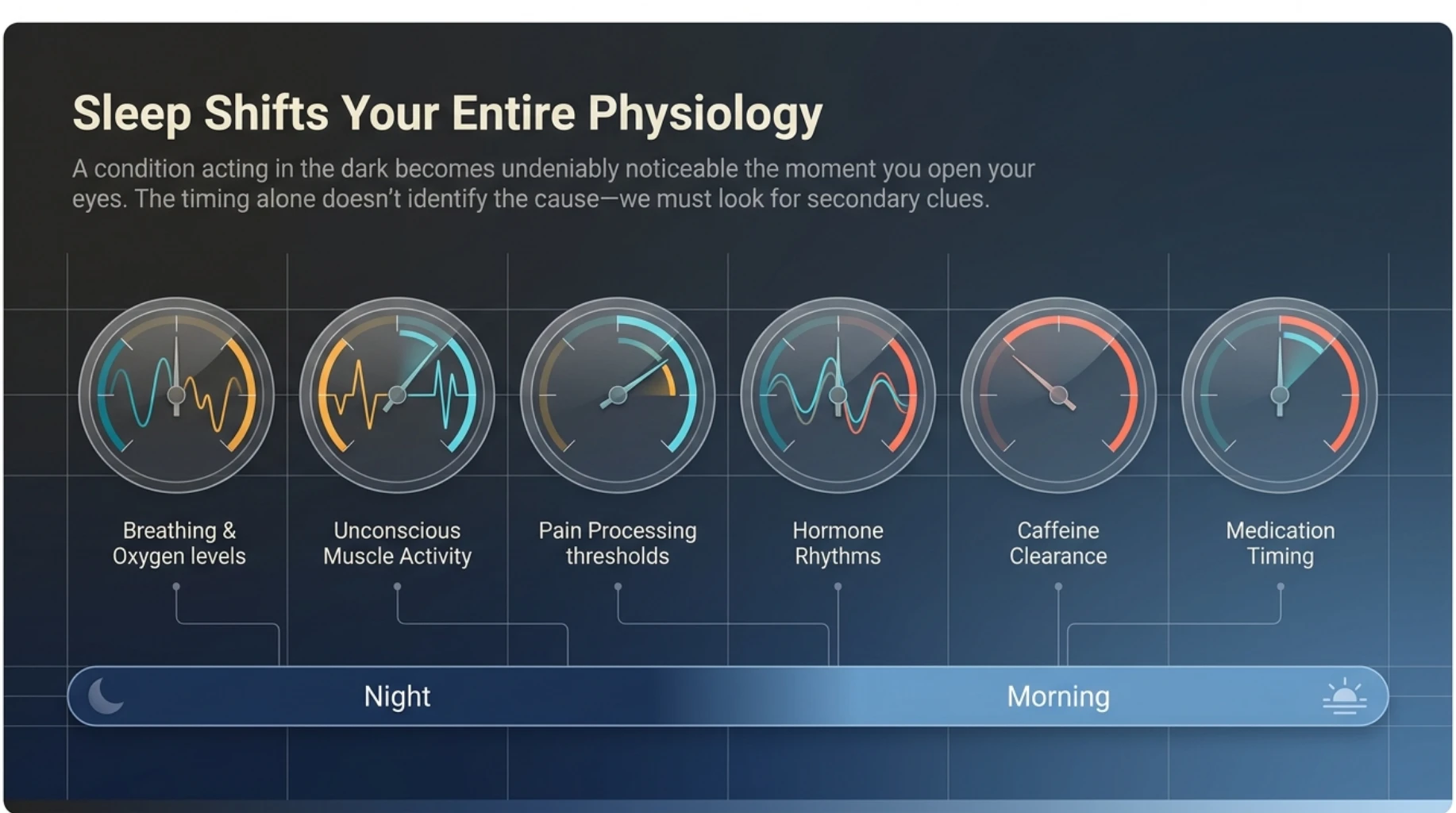
Morning timing is a clue—not a diagnosis.
Sleep changes several physiological systems at once:
- breathing
- oxygen and carbon-dioxide levels
- muscle activity
- pain processing
- hormone rhythms
- caffeine exposure
- the timing of headache medicines
A condition acting during the night can therefore become most noticeable when you wake.
At the same time, an ordinary migraine attack may begin during sleep and simply still be present in the morning. MedlinePlus notes that migraine attacks are commonly experienced in the morning and that some people wake with them.
It is useful to distinguish several patterns.
Pain present immediately on opening the eyes may raise questions about sleep-related factors.
Pain appearing after standing up may suggest a different physiological pattern.
A headache that wakes you from sleep is also different from simply noticing one when the alarm goes off.
And a headache accompanied by new weakness, confusion, double vision, loss of consciousness or another neurological symptom requires more urgent assessment than a familiar recurrent headache with a stable pattern.
A headache diary can help separate these patterns later in the evaluation.
Reason 1: Obstructive Sleep Apnea Can Cause Morning Headaches
Obstructive sleep apnea is one of the first conditions worth considering when repeated headaches occur on waking.
During obstructive sleep apnea, the upper airway repeatedly narrows or closes during sleep. Breathing can stop and restart many times, fragmenting sleep and sometimes lowering blood oxygen levels.
The National Heart, Lung, and Blood Institute lists headache among recognized sleep-apnea symptoms, together with:
- loud snoring
- breathing that repeatedly starts and stops
- gasping during sleep
- daytime sleepiness
- fatigue
- dry mouth
- waking frequently at night
The International Classification of Headache Disorders also recognizes sleep apnea headache as a specific secondary headache disorder. It describes it as a morning headache occurring in association with diagnosed sleep apnea and typically improving when the sleep apnea improves.
However, waking with head pain does not prove you have sleep apnea.
A 2024 systematic review involving more than 15,000 people found that headaches were fairly common among patients with obstructive sleep apnea, with morning headaches reported in roughly one-third. Yet the overall evidence did not establish that obstructive sleep apnea universally increases headache risk compared with people without it.
So morning headache is best treated as one clue among several.
Morning Headaches With Snoring or Daytime Sleepiness Need a Sleep Review
Sleep apnea becomes more plausible when the headache occurs alongside symptoms such as:
- habitual loud snoring
- observed pauses in breathing
- waking while choking or gasping
- excessive daytime sleepiness
- unrefreshing sleep
- frequent nighttime urination
A partner’s observation can be particularly useful because many people are unaware that their breathing repeatedly stops while they are asleep.
NHLBI notes that a sleep study may be needed when symptoms suggest sleep apnea.
Morning headache should not be used as a substitute for proper sleep-apnea assessment.
This is particularly important because treating the underlying sleep disorder may matter for far more than the headache. Sleep apnea is also associated with broader cardiovascular and metabolic consequences.
Reason 2: Teeth Grinding or Jaw Clenching During Sleep
Sometimes the source of morning head pain is closer to the jaw than the brain.
Bruxism refers to grinding, clenching or gnashing the teeth. It can occur while awake or during sleep.
Because sleep bruxism occurs unconsciously, someone may not realize they are doing it.
The National Institute of Dental and Craniofacial Research lists several possible consequences of bruxism, including:
- jaw-muscle soreness
- jaw tightness
- tired jaw muscles
- headache
- facial pain
- damaged or worn teeth
A person may therefore describe:
“I wake with a tight jaw and pain around my temples.”
Another clue may come from a partner hearing grinding noises during the night.
Severe or persistent bruxism can also produce tooth sensitivity, flattened teeth or damage to dental restorations.
Not every morning headache with jaw discomfort is bruxism, however.
Temporomandibular disorders, commonly shortened to TMD, can also cause pain in the jaw joint and chewing muscles. NIDCR recognizes headaches associated with TMD as part of the broader group of temporomandibular disorders.
Jaw Pain Can Be an Important Clue When You Wake With a Headache
Look for associated features such as:
- tightness around the temples
- jaw soreness on waking
- pain when chewing
- tooth sensitivity
- worn or chipped teeth
- facial muscle tenderness
- painful jaw clicking or reduced movement
These clues make a dental or jaw-muscle assessment more relevant.
But avoid assuming that everyone with morning headaches needs a night guard.
NIDCR notes that evidence for oral appliances in TMD-related pain is limited and recommends conservative approaches rather than treatments that permanently alter the teeth or bite.
The cause needs to be identified first.
A person with migraine and incidental jaw clicking should not automatically be treated as though the jaw is causing every headache.
Reason 3: Migraine Can Begin During Sleep or Be Present on Waking
Migraine does not always begin after you have been awake for several hours.
Some attacks start overnight, while others are already established by the time a person wakes.
MedlinePlus specifically notes that migraine is more common in the morning and that some people wake with an attack.
Migraine becomes more likely when morning pain is accompanied by features such as:
- throbbing or pulsating pain
- pain that is worse with ordinary movement
- nausea or vomiting
- sensitivity to light
- sensitivity to sound
- visual or sensory aura in some people
The pain may be one-sided, but migraine does not have to remain confined to one side.
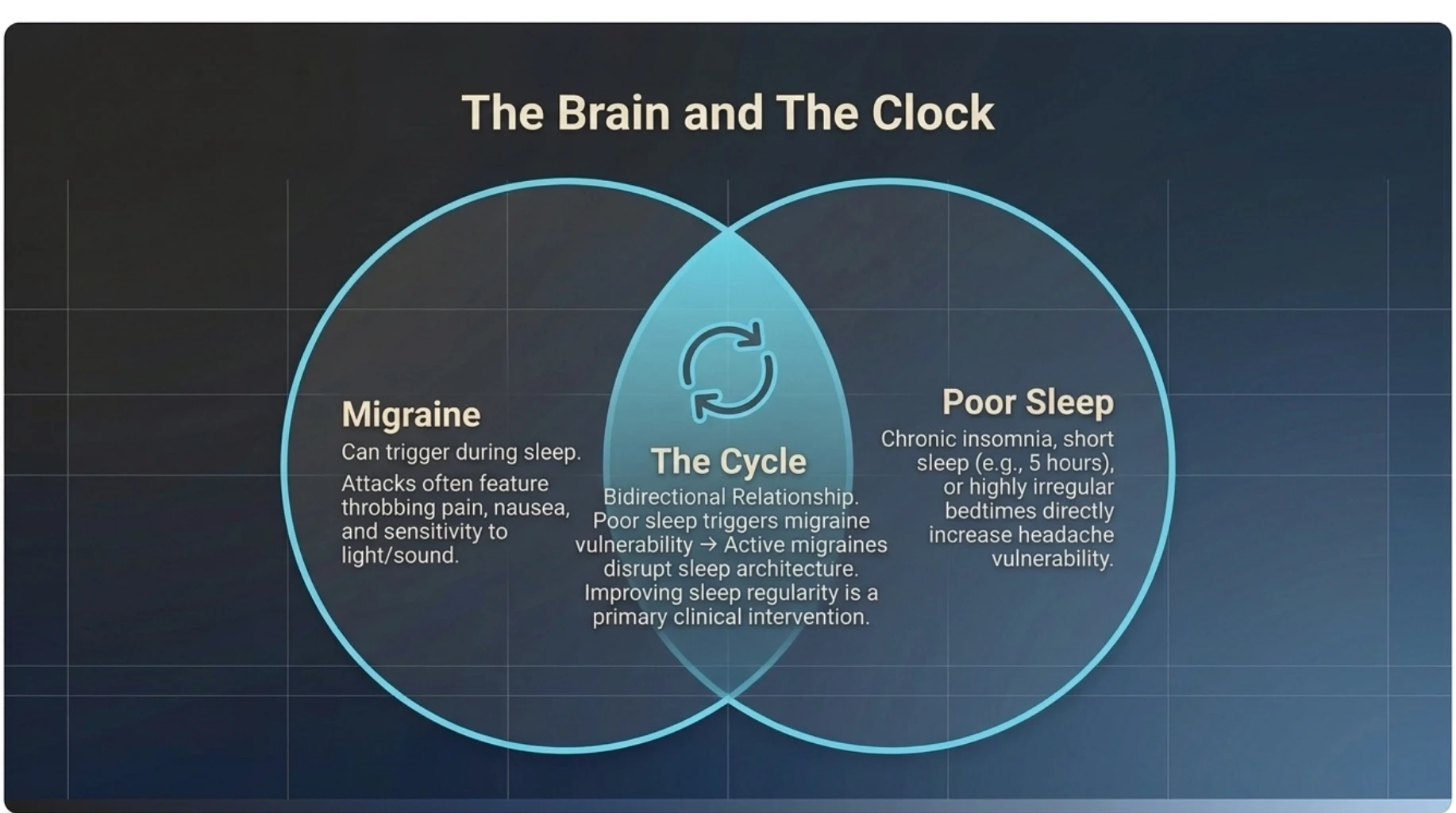
Sleep and migraine also have a complicated two-way relationship.
A 2026 American Migraine Foundation review notes that insomnia, frequent nighttime awakenings and unrefreshing sleep are more common among people with migraine. Poor sleep can increase vulnerability to attacks, while migraine itself can disrupt sleep.
NINDS similarly lists too much or too little sleep among factors that can trigger migraine attacks in susceptible people.
This means waking with migraine does not necessarily indicate a separate overnight disease.
For someone with a known migraine pattern, morning attacks may represent the timing of the primary headache disorder itself.
The important distinction is whether the pattern is familiar and stable—or whether a new type of morning headache has appeared.
A previously diagnosed migraine that has suddenly become daily, substantially more severe or neurologically different deserves reassessment rather than simply increasing painkillers.
Reason 4: Poor Sleep, Insomnia or an Irregular Sleep Schedule
A headache after waking does not always mean something specific happened to the head overnight.
Sometimes the problem is the sleep itself.
Headache disorders and sleep problems have a strong two-way relationship. A 2026 clinical review found that insomnia and other sleep disorders frequently coexist with migraine and tension-type headache, and that poor sleep is associated with greater headache burden in many patients.
Possible patterns include:
- repeatedly sleeping too little
- difficulty falling asleep
- frequent nighttime awakenings
- highly irregular bedtimes
- major differences between weekday and weekend sleep
- sleeping much longer than usual
- shift-work-related disruption
Someone may notice:
“I wake with headaches after nights when I sleep only five hours.”
Another person may experience headaches after staying up very late on Friday and sleeping until midday on Saturday.
This does not prove that sleep loss is the sole cause.
Migraine itself can disrupt sleep, and people with recurrent headache disorders have higher rates of insomnia. The relationship can therefore run in both directions rather than following a simple chain of “poor sleep causes headache.”
Improving sleep regularity can nevertheless be an important part of headache management when the pattern is consistent.
Look at:
- bedtime
- wake time
- total sleep duration
- nighttime awakenings
- snoring
- daytime sleepiness
If insomnia is persistent rather than occasional, it may deserve direct treatment rather than relying indefinitely on sleeping tablets.
Reason 5: Overnight Caffeine Withdrawal
Caffeine deserves attention because both excessive intake and withdrawal can be associated with headache.
A common pattern is:
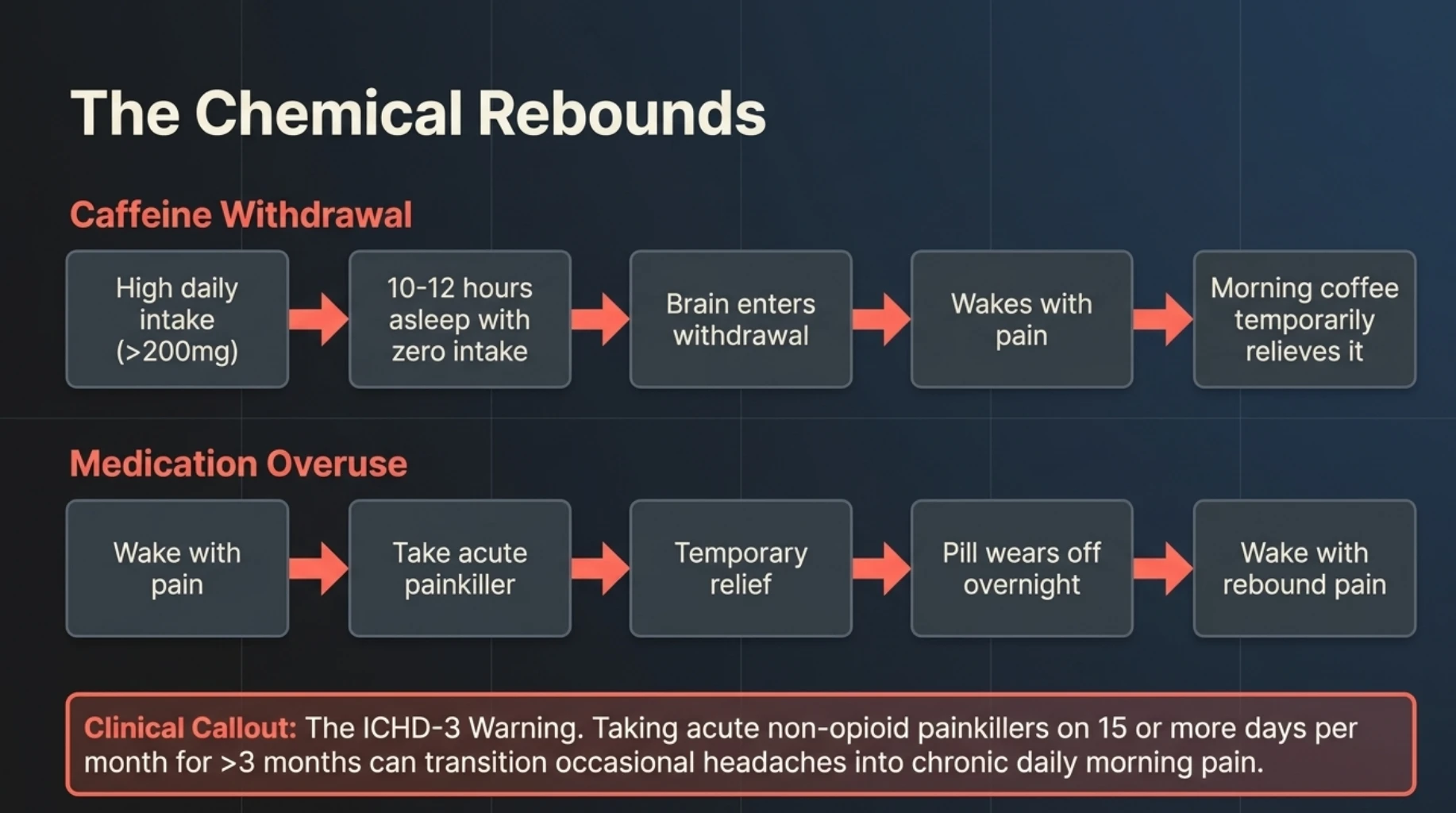
several cups of tea or coffee through the day → no caffeine for 10–12 hours overnight → headache on waking
The International Classification of Headache Disorders formally recognizes caffeine-withdrawal headache.
Its diagnostic criteria describe headache developing within 24 hours after stopping or delaying regular caffeine intake exceeding 200 mg per day for more than two weeks. The headache should improve after caffeine is resumed or resolve after withdrawal is completed.
That does not mean everyone who drinks morning tea and has a headache is experiencing caffeine withdrawal.
It becomes more plausible when:
- caffeine consumption is substantial and regular
- headache appears when the usual dose is delayed
- weekend headaches occur after sleeping later than usual
- pain improves soon after tea or coffee
- headaches begin when caffeine intake is suddenly reduced
Remember that caffeine comes from more than coffee.
Sources may include:
- tea
- coffee
- energy drinks
- cola
- some pre-workout products
- certain headache medicines
If caffeine withdrawal seems likely, suddenly going from high daily consumption to zero may temporarily make headaches worse.
A gradual reduction may be easier for some people.
At the same time, repeatedly treating every headache with caffeine can complicate the pattern, particularly when caffeine-containing combination painkillers are also being used frequently.
Reason 6: Frequent Painkiller Use and Medication-Overuse Headache
This sounds counterintuitive:
medicine taken to stop headaches can sometimes contribute to more frequent headaches.
Medication-overuse headache typically develops in someone who already has a primary headache disorder—often migraine or tension-type headache—and uses acute headache medicines too frequently.
According to ICHD-3, medication-overuse headache involves headache on 15 or more days per month together with regular overuse of acute or symptomatic headache medicines for more than three months. The number of medication-use days considered excessive depends on the medicine involved.
For common non-opioid painkillers such as paracetamol or NSAIDs, the ICHD-3 threshold is generally use on 15 or more days per month for more than three months.
Some other headache medicines have lower overuse thresholds.
A person may describe:
“I wake with a headache, take a painkiller, feel better, and then the headache returns the next morning.”
Over time, headache days can become more frequent.
This is one reason it is useful to record medication days, not simply the number of tablets.
For example:
Taking paracetamol three times on one day counts differently from taking it on three separate days when assessing medication-overuse patterns.
Do not abruptly stop prescribed medicines without guidance, particularly if you are using combination medicines, opioids or other treatments that may require a planned withdrawal strategy.
The underlying migraine or headache disorder may also need preventive treatment so that repeated rescue medication becomes less necessary.
Does High Blood Pressure Cause Morning Headaches?
High blood pressure is commonly blamed for headache.
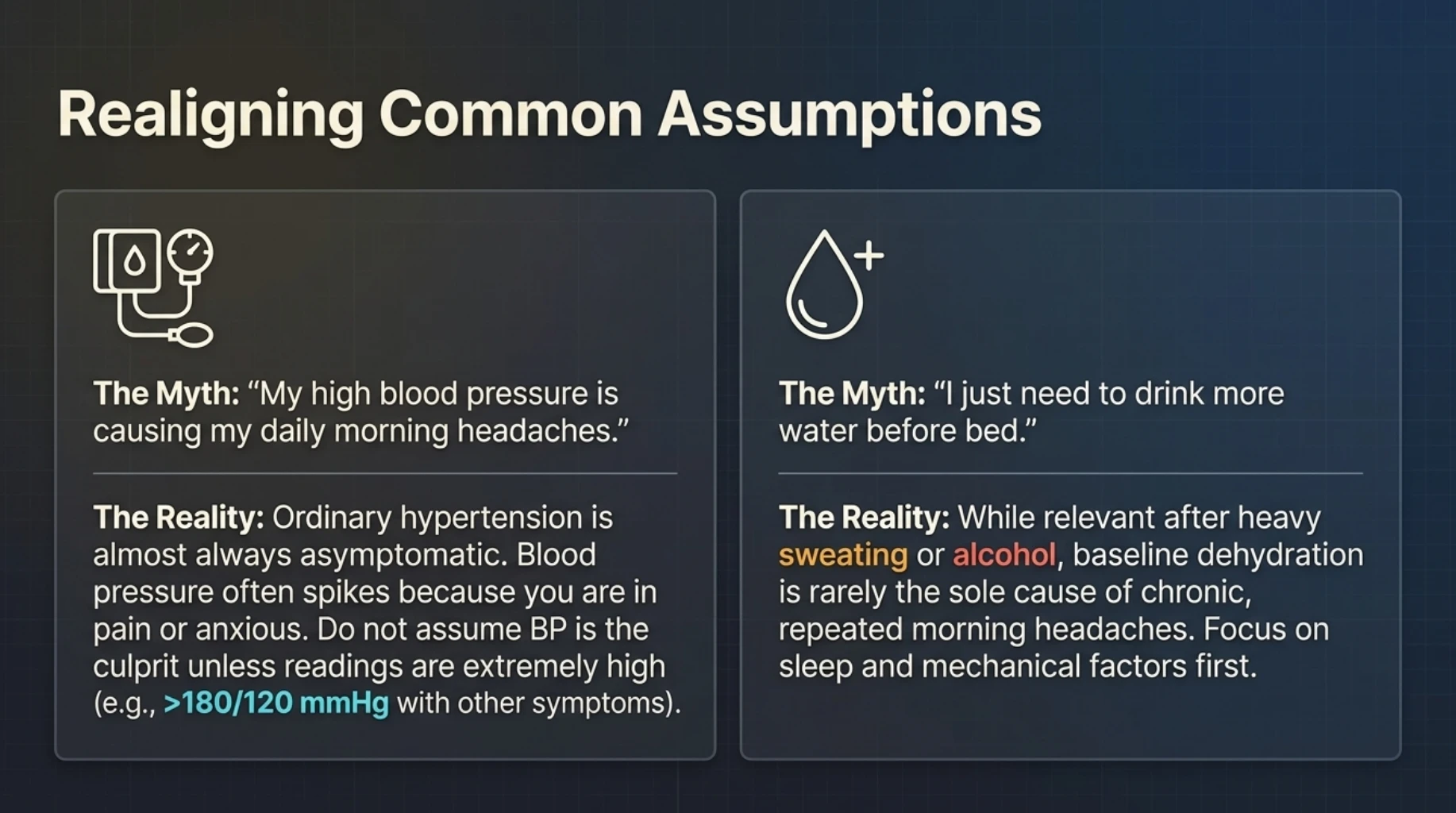
Most ordinary hypertension, however, causes no symptoms at all.
The American Heart Association describes hypertension as a condition that is usually asymptomatic. WHO similarly states that most people with high blood pressure do not feel symptoms, although very high blood pressure can cause severe headache and other symptoms.
Therefore: morning headache does not prove that blood pressure is high and high blood pressure does not automatically explain a chronic headache pattern.
If you repeatedly wake with headaches, measuring blood pressure correctly can still be useful—particularly if hypertension has already been diagnosed.
But avoid checking blood pressure only while in significant pain and assuming the elevated reading caused the headache. Pain and anxiety can themselves temporarily increase blood pressure.
A different situation occurs when blood pressure is extremely high.
For a nonpregnant adult, a reading above 180/120 mmHg accompanied by neurological symptoms, chest pain, significant breathlessness, visual change or other concerning symptoms requires urgent evaluation.
Persistent morning headaches should therefore be assessed on their own clinical merits rather than automatically attributed to “BP.”
When Morning Headaches Need Urgent Medical Assessment
Most recurrent headaches are not caused by a dangerous brain disorder.
But some headache patterns require prompt assessment.
NINDS advises urgent medical evaluation for warning features including:
- a sudden severe or “worst-ever” headache
- headache with weakness or loss of sensation
- confusion or loss of consciousness
- double vision or other significant neurological changes
- seizure
- headache after a significant head injury
- headache worsening progressively over days or weeks
- a major change from the person’s usual headache pattern
- a new persistent headache after age 50
- a new headache in someone with certain serious underlying illnesses
A particularly important pattern is the thunderclap headache—pain that becomes extremely severe very rapidly.
That is not a headache to watch at home for several days.
Sudden severe headache can occur with conditions requiring urgent investigation, including bleeding around the brain.
Other reasons to seek prompt assessment include a new headache associated with:
- high fever and neck stiffness
- repeated vomiting
- progressive neurological symptoms
- substantial change in behaviour
- pregnancy or the postpartum period with concerning symptoms
- severe uncontrolled hypertension
A longstanding familiar migraine that occasionally appears in the morning is very different from a completely new severe headache that wakes you suddenly from sleep.
Morning Headache in Several People at Home: Think About Carbon Monoxide
There is one uncommon but particularly important clue:
more than one person in the same home develops headache, dizziness or nausea—especially after sleeping.
Carbon monoxide is an odorless, colorless gas produced by incomplete combustion.
Possible household sources include malfunctioning fuel-burning appliances, generators, charcoal burning and other combustion sources used in enclosed or poorly ventilated spaces.
CDC lists common carbon-monoxide poisoning symptoms including:
- headache
- dizziness
- weakness
- nausea or vomiting
- chest pain
- confusion
CDC specifically advises clinicians to consider carbon-monoxide poisoning when multiple people have similar unexplained symptoms, particularly when an exposure source may be present.
If carbon-monoxide exposure is suspected, move to fresh air and seek urgent medical assistance rather than simply going back to sleep or taking a painkiller.
What Should You Track Before Seeing a Doctor?
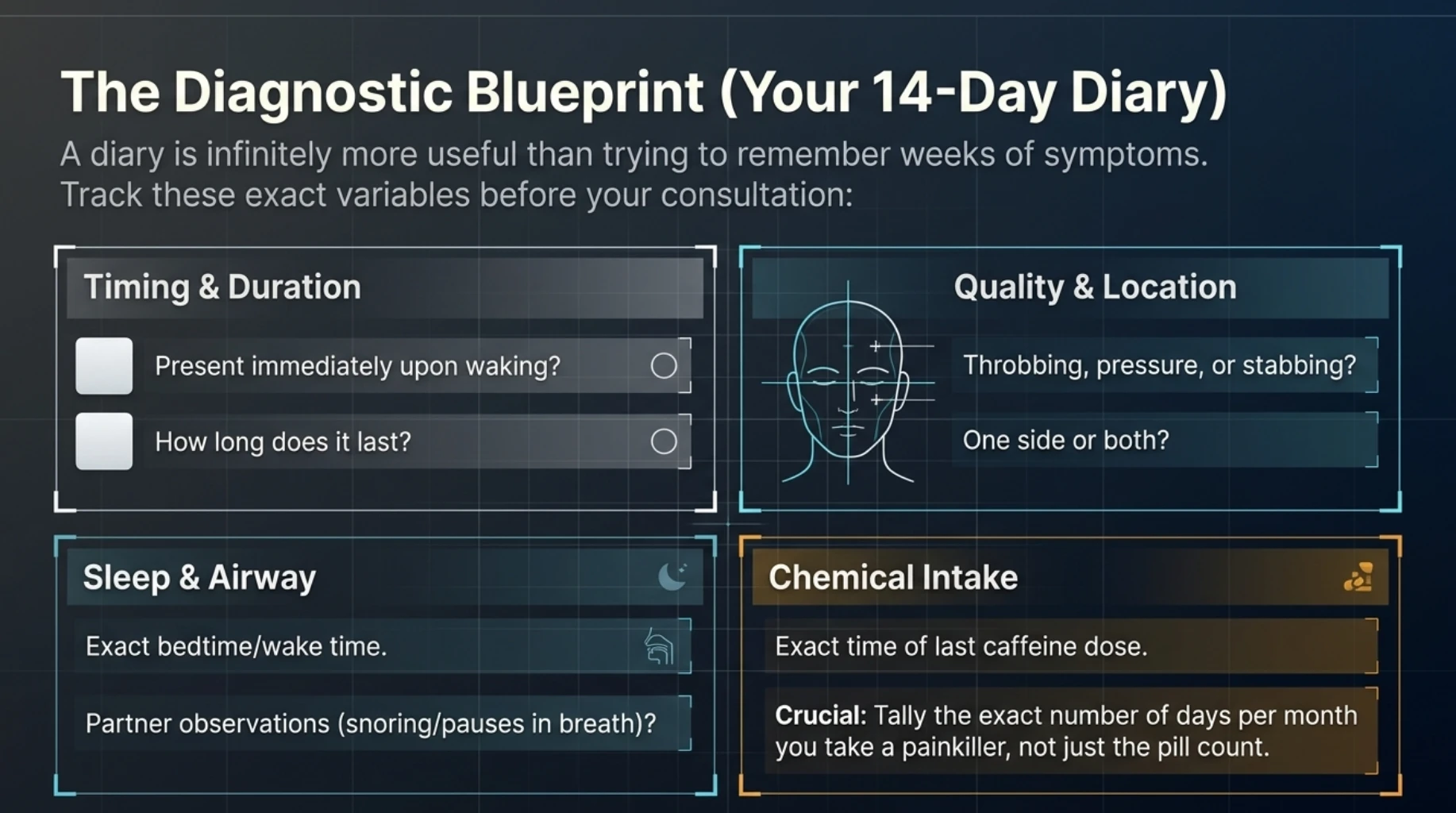
A headache diary is often more useful than trying to remember several weeks of symptoms during one consultation.
For two to four weeks, consider recording:
Time:
Was the headache present the moment you woke, or did it appear later?
Duration:
Did it last 20 minutes, two hours or most of the day?
Location:
One side, both temples, forehead, back of the head or around the eyes?
Quality:
Throbbing, pressure, tightness, stabbing or another sensation?
Associated symptoms:
Nausea, vomiting, light sensitivity, sound sensitivity, dizziness, visual symptoms or weakness?
Sleep:
Bedtime, wake time, approximate sleep duration and whether sleep felt refreshing.
Snoring:
Has someone noticed loud snoring, pauses in breathing or gasping?
Jaw symptoms:
Jaw soreness, grinding, tooth sensitivity or temple pain on waking?
Caffeine:
How much tea, coffee or other caffeine did you consume, and when was the last intake?
Painkillers:
Record the medicine and, importantly, the number of days per month you take it.
Patterns may become obvious.
For example:
Headache only after late nights + irregular wake time
is different from:
daily headache + loud snoring + marked daytime sleepiness.
The diary does not diagnose the cause, but it can make the consultation much more informative.
Which Tests May Be Needed for Repeated Morning Headaches?
There is no universal “morning headache test panel.”
Investigation depends on the history and examination.
Blood Pressure
Blood pressure is worth measuring, particularly when hypertension is known or suspected.
But ordinary hypertension should not automatically be assumed to explain the headache because most people with hypertension have no symptoms.
Sleep Assessment
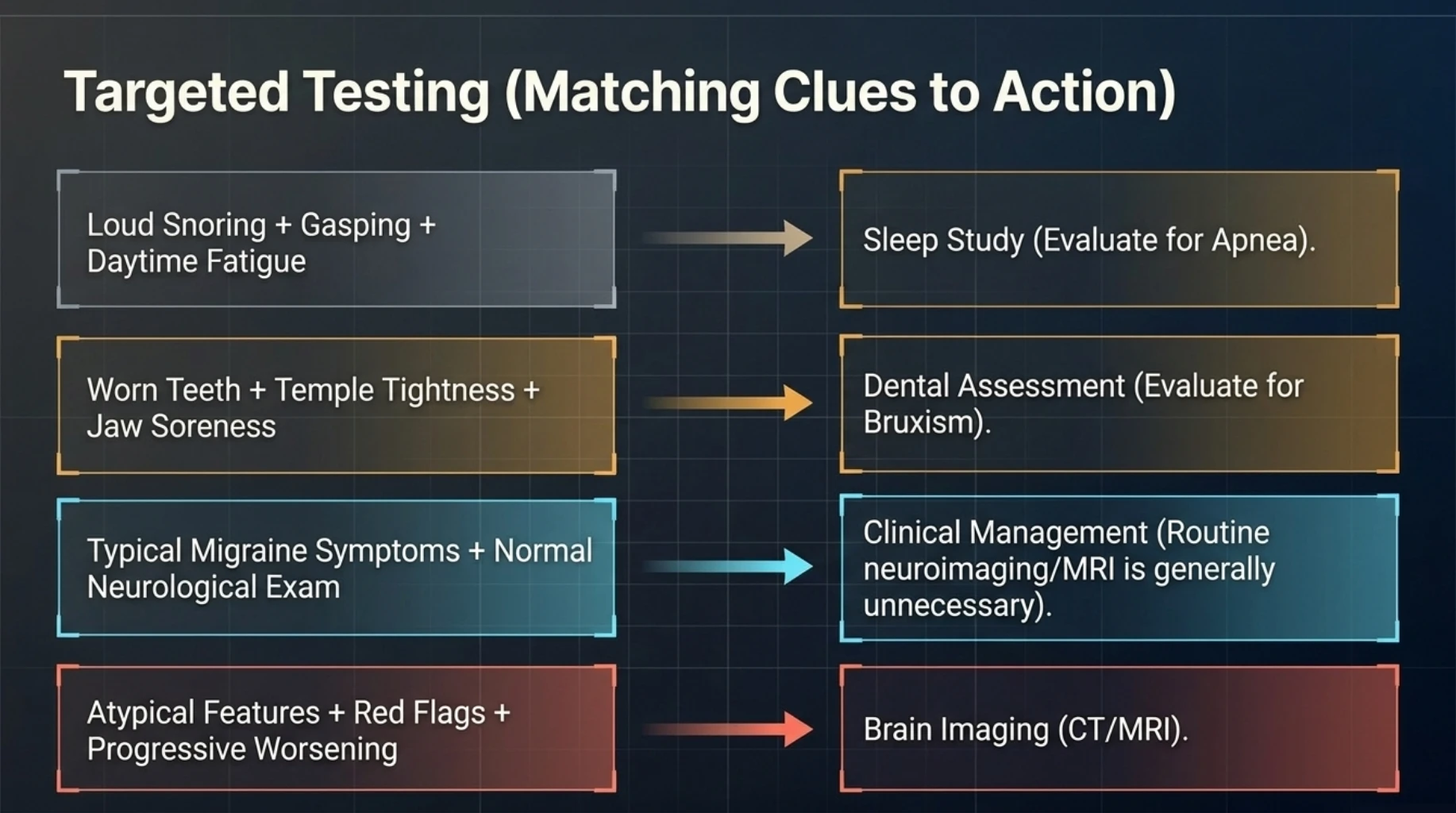
When loud snoring, witnessed breathing pauses, gasping or excessive daytime sleepiness are present, evaluation for obstructive sleep apnea may be appropriate.
That may eventually involve a sleep study.
Dental or Jaw Assessment
Jaw tenderness, significant tooth wear or suspected sleep bruxism may justify dental evaluation.
Blood Tests
Blood tests are not required for every headache.
They may be selected when the history suggests problems such as:
- anemia
- thyroid dysfunction
- infection
- another systemic illness
Brain Imaging
Morning timing by itself is not a reason that everyone needs an MRI.
The American Headache Society states that routine neuroimaging is generally unnecessary in patients whose headaches have typical migraine features, whose neurological examination is normal and who have no concerning red flags.
Imaging becomes more relevant when features are atypical, neurological examination is abnormal or the headache has warning signs such as:
- first or worst severe headache
- progressive worsening
- substantial change in pattern
- persistent unusual neurological symptoms
- post-traumatic headache
- other signs suggesting a secondary cause
The objective is targeted evaluation, not automatically ordering CT, MRI and extensive blood tests for every person who wakes with pain.
Morning Headache Assessment at Diet Plus Minus in Dwarka
Repeated morning headaches can initially be assessed in general medical care.
Dr. Pankaj Kumar can review:
- headache timing and frequency
- migraine-type symptoms
- sleep duration and quality
- snoring and possible sleep-apnea symptoms
- jaw or teeth-grinding symptoms
- caffeine use
- painkiller frequency
- blood pressure
- current medicines
- relevant previous laboratory reports
- neurological warning symptoms
- whether further testing or specialist referral is appropriate
Depending on the findings, referral may be appropriate for sleep evaluation, dental assessment, neurology or another relevant specialty.
Bring a headache diary if possible.
Also bring a list of all medicines taken for headache—including over-the-counter painkillers—because medication frequency can be an important part of the diagnosis.
Dr. Pankaj Kumar
MBBS, DNB Family Medicine, Sir Ganga Ram Hospital
General & Lifestyle Physician
Special interest in Diabetes
Diet Plus Minus
13A, Pocket-2, Sector-6, Doctors Lane
Dwarka, New Delhi – 110075
India
Book an Appointment with Dr. Pankaj Kumar
Frequently Asked Questions
Why Do I Wake Up With a Headache Every Morning?
There is no single cause.
Repeated morning headaches can occur with sleep apnea, migraine, teeth grinding, poor sleep, caffeine withdrawal or medication overuse.
A daily or progressively worsening pattern deserves medical review rather than repeated self-treatment with painkillers.
Can Sleep Apnea Cause Morning Headaches?
Yes.
Headache on waking is a recognized symptom associated with obstructive sleep apnea, particularly when it occurs with snoring, witnessed breathing pauses, gasping or daytime sleepiness.
Morning headache alone cannot diagnose sleep apnea.
What Does a Sleep Apnea Headache Feel Like?
The ICHD-3 description commonly characterizes sleep-apnea headache as occurring on awakening and often having a pressing quality rather than classic migraine features.
However, real patients can have overlapping headache disorders, so the character of the pain alone cannot reliably diagnose sleep apnea.
Can Teeth Grinding Cause a Headache in the Morning?
Yes.
Sleep bruxism can cause morning jaw-muscle discomfort, facial pain and headache.
Jaw soreness, worn teeth or a partner hearing tooth grinding can make this explanation more plausible.
Can Migraine Start While I Am Sleeping?
Yes.
Migraine attacks can begin overnight and be present on waking.
Migraine becomes more likely when headache is accompanied by nausea, sensitivity to light or sound, throbbing pain or a familiar previous migraine pattern.
Can Poor Sleep Cause Morning Headaches?
Poor-quality or insufficient sleep is associated with headache disorders, particularly migraine and tension-type headache.
Recent evidence also supports a bidirectional relationship: headache can worsen sleep, while disturbed sleep can increase headache burden.
Can Sleeping Too Long Cause a Headache?
It can trigger migraine in some susceptible people.
Sleeping late can also delay the usual caffeine dose, potentially adding a caffeine-withdrawal component.
An irregular weekend sleep schedule is therefore worth recording if headaches repeatedly occur on days off.
Can Caffeine Withdrawal Cause a Morning Headache?
Yes.
ICHD-3 recognizes caffeine-withdrawal headache after regular substantial caffeine consumption is stopped or delayed. Headache generally develops within 24 hours of the last intake.
Why Do I Get a Headache When I Sleep Late on Weekends?
Two factors may overlap:
- changing the usual sleep schedule
- delaying your normal morning caffeine
A headache diary can help reveal whether weekend headaches follow this repeated pattern.
Can Taking Too Many Painkillers Cause Daily Headaches?
Yes.
Medication-overuse headache can develop in people with a pre-existing headache disorder who use acute headache medication too frequently over several months.
The threshold depends on the medication, so review the number of medication-use days per month with your clinician.
Does High Blood Pressure Cause Headaches in the Morning?
Ordinary hypertension usually causes no symptoms.
Very high blood pressure can be associated with severe headache, particularly when other symptoms of acute organ involvement are present.
Do not assume that every morning headache is caused by blood pressure.
Should I Check My Blood Pressure When I Wake With a Headache?
It can be reasonable, particularly if you have hypertension.
Measure after sitting quietly and use a validated upper-arm device where possible.
Remember that pain and anxiety may temporarily influence blood pressure, so one reading should be interpreted in context.
Does Dehydration Cause Morning Headaches?
Dehydration can contribute to headache in some people, particularly after illness, heavy alcohol intake, significant sweating or inadequate fluid intake.
However, repeatedly waking with headaches should not automatically be blamed on dehydration when other clues suggest migraine, sleep apnea or medication overuse.
Does Alcohol Cause Headaches the Next Morning?
Yes, alcohol can be associated with delayed headache as well as dehydration and disrupted sleep.
If morning headache consistently follows alcohol intake, recording the timing and quantity can help clarify the relationship.
Do I Need an MRI for Morning Headaches?
Not automatically.
Neuroimaging is generally unnecessary for typical recurrent migraine with a normal neurological examination and no warning features.
A new, progressive, unusual or neurologically complicated headache may require imaging depending on clinical assessment.
Is It Concerning if a Headache Wakes Me From Sleep?
It deserves attention if it is new, recurrent, severe or changing.
Some primary headache disorders can occur during sleep, so this feature does not automatically mean a serious brain disorder.
The overall pattern, neurological examination and presence of other red flags determine whether further investigation is needed.
When Is a Morning Headache an Emergency?
Seek urgent medical assessment for a sudden severe headache, new neurological weakness or numbness, confusion, loss of consciousness, seizure, significant visual or speech disturbance, or another major abrupt change.
A severe headache with extremely high blood pressure and neurological, visual, respiratory or chest symptoms also needs urgent assessment.
Why Do Several People in My House Have Headaches in the Morning?
Shared headache, dizziness, nausea or weakness can raise concern about carbon-monoxide exposure, particularly when fuel-burning equipment is present.
CDC specifically lists multiple people with similar symptoms as an important clue to possible carbon-monoxide poisoning.
Move to fresh air and seek urgent medical assistance if exposure is suspected.
Author Box
Dr. Pankaj Kumar
MBBS, DNB Family Medicine, Sir Ganga Ram Hospital
General & Lifestyle Physician
Special interest in Diabetes
Dr. Pankaj Kumar provides general medical and lifestyle-based care at Diet Plus Minus in Dwarka, New Delhi. His clinical approach includes assessment of common adult symptoms such as recurrent headaches, poor sleep, blood-pressure concerns and related metabolic-health factors, with appropriate investigation or specialist referral when required.
Medical Disclaimer
This article provides general educational information and does not replace an individual medical consultation, neurological examination, diagnosis or personalized treatment plan.
Do not repeatedly increase painkiller use for recurrent headaches without reviewing the underlying pattern.
Seek urgent medical attention for a sudden severe or worst-ever headache, new weakness or numbness, confusion, loss of consciousness, seizure, significant visual or speech disturbance, or another major acute neurological change.
If several people in the same building develop unexplained headache, dizziness or nausea and carbon-monoxide exposure is possible, move to fresh air and seek urgent medical help.
References
- International Headache Society. ICHD-3: Sleep Apnea Headache. Recognizes headache on awakening associated with obstructive sleep apnea while emphasising that morning headache is nonspecific.
- National Heart, Lung, and Blood Institute. Sleep Apnea: Symptoms. Reviews snoring, witnessed breathing pauses, gasping, daytime sleepiness, fatigue and headache associated with sleep apnea.
- National Institute of Dental and Craniofacial Research. Bruxism. Reviews teeth grinding and clenching, jaw-muscle symptoms, dental effects and associated headache.
- International Headache Society. ICHD-3: Caffeine-Withdrawal Headache. Defines caffeine-withdrawal headache following interruption or delay of regular substantial caffeine use.
- International Headache Society. ICHD-3: Medication-Overuse Headache. Defines medication-overuse headache and medication-specific overuse thresholds.
- Sleep and Headache Disorders: What a Clinician Needs to Know. 2026 review describing the frequent coexistence of sleep disorders, migraine and tension-type headache and the importance of sleep assessment in headache care.
- Interventions for Migraine and Sleep: A Systematic Review Exploring Their Bidirectional Association. 2026 systematic review evaluating the interaction between migraine and sleep disturbances.
- World Health Organization. Hypertension. Updated 2025. Notes that hypertension is usually asymptomatic while very high blood pressure may cause headache and other symptoms.
- American Heart Association. What Are the Signs and Symptoms of High Blood Pressure? Explains that ordinary hypertension usually causes no symptoms.
- National Institute of Neurological Disorders and Stroke. Headache. Reviews headache warning signs requiring prompt medical assessment and the clinical approach to diagnosis.
- American Headache Society. Neuroimaging for Migraine: Evidence-Based Guidance. States that routine imaging is generally unnecessary for typical migraine when neurological examination is normal and no red flags are present.
- Centers for Disease Control and Prevention. Carbon Monoxide Poisoning Basics and Clinical Guidance. Reviews headache and other manifestations of carbon-monoxide poisoning and highlights multiple people with similar symptoms as an important exposure clue.
Related reading and care options

Written by Dr. Pankaj Kumar
General & Lifestyle Physician in Dwarka Sector 6, New Delhi · MBBS, DNB (Family Medicine), DNHE · 16 years of experience.
About the doctor →Book a consultation → Beyond Blood Sugar
 The 90-Day Prediabetes Turnaround
 The Indian Diabetes Diet Reset
 Eat to Beat Gout
 Why Is My Hair Falling?
 The 30-Day Inflammation Reset