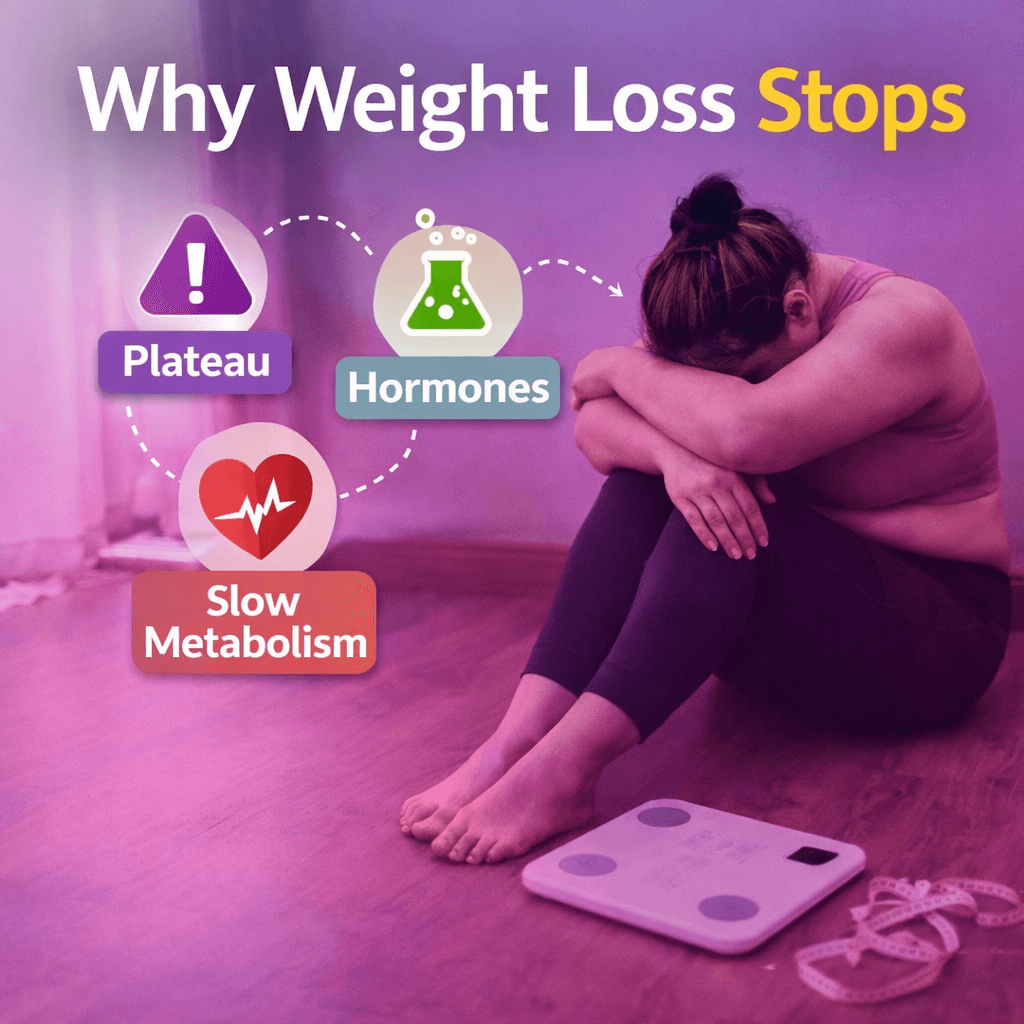
One of the most frustrating moments in any fat-loss journey is this: the scale moves well for a few weeks, motivation rises, clothes start fitting better, and then progress suddenly slows down or stops.
This is exactly when many people start asking why weight loss stops even though they are still trying.
The answer is usually not laziness or lack of discipline. In many cases, the body is adapting. As body weight falls, energy needs also fall. Hunger signals often rise. Daily movement may quietly reduce. If muscle mass is not preserved well, calorie burn falls even further. Together, these changes create a plateau. Modern obesity science describes this as a biologic response to weight loss rather than a simple failure of willpower.
If you are trying to understand whether your plateau is behavioral, metabolic, or both, the doctor-supervised Weight Loss Program explains how structured medical review differs from random dieting.

What Happens Inside the Body During a Plateau
To understand why weight loss stops, it helps to think beyond calories alone. Your body is not a static machine. When you lose weight, the body usually responds by defending its remaining energy stores. Resting energy expenditure can drop more than expected for the new body size. Hunger may increase. Satiety may weaken. Some people also move less without noticing, which lowers total daily calorie burn. Reviews on metabolic adaptation and obesity set-point biology describe this pattern clearly.
That is why early weight loss is often easier than later fat loss. The first phase may include water loss, reduced glycogen stores, and strong motivation. The next phase becomes slower because the body is actively trying to restore balance.
This is also why I prefer to frame a plateau as a physiologic checkpoint, not as failure.
1. Metabolic Adaptation
The most important medical explanation for why weight loss stops is metabolic adaptation.
Metabolic adaptation means your body starts using less energy than expected after weight loss. In simple terms, it becomes more efficient. That sounds helpful, but during dieting it makes further loss harder. A 2022 study found that metabolic adaptation increased the time needed to reach weight-loss goals in women with overweight, even after adjusting for adherence.
A 2022 review also explained that adaptive thermogenesis is a real and clinically relevant reason why fat loss slows down over time.
This does not mean progress becomes impossible. It means the plan often needs adjustment.
2. Lower Daily Calorie Burn
As body weight comes down, your body simply needs fewer calories to maintain itself. A lighter body burns less energy during rest and movement. Even walking the same distance may burn fewer calories after weight loss than it did before.
This is one of the simplest reasons why weight loss stops. The calorie deficit that worked in month one may no longer be large enough in month three. That is especially true when dieting has not been matched with resistance training and enough protein.
Many people also unconsciously reduce daily movement when they diet. They sit a little more, move a little less, and feel a little more tired. That small reduction matters.
If weight loss has stalled and you also notice central fat gain or fatty liver risk, this article on fatty liver treatment without medication is worth reading because weight plateaus and fatty liver often overlap metabolically.
3. Appetite Hormones Fight Back
Another important reason why weight loss stops involves hormones that regulate hunger and satiety.
When body fat decreases, the body often increases the production of ghrelin, the hormone responsible for stimulating hunger. At the same time, leptin levels decline. Leptin normally signals fullness and energy sufficiency to the brain.
This hormonal shift creates a powerful biological push to regain lost weight. People may feel hungrier, crave calorie-dense foods, and think about food more often than before.
This effect is not psychological weakness. It is a physiological response designed to preserve energy stores. Studies on obesity physiology have shown that hormonal changes during weight loss can persist for months or even years.
Because of this hormonal response, long-term weight control requires structured strategies rather than short-term dieting.
4. Muscle Loss During Dieting
Muscle plays a crucial role in metabolic health. Muscle tissue burns more calories than fat tissue even when the body is at rest.
During aggressive calorie restriction, some individuals lose muscle mass along with fat. When muscle mass decreases, the body’s resting metabolic rate drops. This reduction in energy expenditure contributes to plateaus and is another explanation for why weight loss stops after initial success.
Preserving muscle requires:
- adequate protein intake
- resistance or strength training
- gradual, sustainable calorie deficits
Without these strategies, the body may adapt by slowing metabolism and conserving energy.
5. Hidden Calorie Drift
Many patients experience gradual calorie increases over time without realizing it. Early in a diet plan, attention to portion size is usually high. As weeks pass, habits may loosen.
Small changes can accumulate significantly:
- slightly larger portions
- extra snacks
- more cooking oil
- sugary beverages
Even a daily increase of 150 to 200 calories can halt weight loss progress. This is one of the most practical explanations for why weight loss stops despite apparently following the same routine.
Tracking food intake for a short period often reveals these hidden calorie patterns.
6. Sleep, Stress, and Cortisol
Sleep and stress also influence weight regulation. Chronic stress activates the hypothalamic-pituitary-adrenal axis and increases cortisol production.
Elevated cortisol can encourage fat storage, particularly around the abdomen. Poor sleep further worsens the situation by altering appetite hormones and increasing cravings.
Short sleep duration has been associated with higher obesity risk in multiple epidemiological studies.
Patients who report poor sleep, late-night eating, and high work stress frequently experience plateaus in fat loss.
7. Medical Conditions and Medications
Sometimes the answer to why weight loss stops lies in underlying medical conditions.
Examples include:
- hypothyroidism
- polycystic ovary syndrome (PCOS)
- insulin resistance
- certain antidepressant medications
- long-term steroid use
These factors can influence metabolism, appetite regulation, and fat storage.
When weight loss plateaus persist despite consistent lifestyle changes, medical evaluation can help identify underlying metabolic issues.
Common Triggers That Cause Weight Loss Plateau
| Trigger | How It Slows Weight Loss | Typical Signs |
|---|---|---|
| Metabolic adaptation | Body burns fewer calories | plateau despite dieting |
| Muscle loss | lower resting metabolism | fatigue, reduced strength |
| Sleep deprivation | hunger hormones increase | late-night cravings |
| Stress | cortisol promotes fat storage | abdominal fat increase |
| Hidden calories | deficit disappears | slow or stalled weight loss |
How to Break a Weight Loss Plateau Safely
When people realize why weight loss stops, the next logical question is how to restart progress. In most cases, breaking a plateau requires adjusting the strategy rather than intensifying dieting.
Many people attempt to reduce calories even further when the scale stops moving. Unfortunately, this often worsens metabolic adaptation and increases hunger hormones. Instead, sustainable fat loss usually improves when lifestyle changes support metabolic health.
1. Recalculate calorie needs
As body weight decreases, daily energy requirements also decline. The calorie deficit that worked in the beginning may no longer be sufficient.
Reviewing current calorie intake and adjusting portion sizes slightly can restore a moderate deficit without extreme restriction.
2. Increase protein intake
Adequate protein helps preserve lean muscle mass during weight loss. Maintaining muscle is important because muscle tissue supports metabolic rate.
Most individuals benefit from distributing protein intake across meals rather than consuming most of it in a single meal.
3. Include resistance training
Strength training helps maintain or increase muscle mass, which supports long-term metabolism.
Exercises such as body-weight training, resistance bands, or weight lifting stimulate muscle tissue and increase energy expenditure.
4. Improve sleep consistency
Sleep plays a critical role in metabolic regulation. Adults who consistently sleep 7–8 hours per night generally show better appetite regulation and metabolic stability.
Poor sleep patterns can increase cravings, reduce energy levels, and contribute to fat storage.
5. Reduce chronic stress
Stress management is often overlooked in weight management programs.
Activities such as regular exercise, mindfulness, yoga, and structured daily routines can help reduce cortisol levels and support metabolic balance.
When to Seek Medical Guidance
In some cases, the answer to why weight loss stops may involve underlying metabolic or hormonal issues.
Medical evaluation becomes particularly important if weight loss plateaus occur together with symptoms such as:
- persistent fatigue
- increasing abdominal fat
- irregular menstrual cycles
- thyroid symptoms
- elevated blood sugar levels
Early medical assessment may help identify conditions such as insulin resistance, hypothyroidism, or metabolic syndrome.
If you are struggling with persistent weight issues, you can read more about the medical approach used in structured weight management on Dr. Pankaj Kumar’s Weight Loss Program.
Key Takeaway
Weight loss plateaus are common and often occur because the body adapts to weight reduction.
Metabolic adaptation, hormonal responses, reduced calorie needs, muscle loss, sleep disruption, stress, and hidden calorie intake all contribute to why weight loss stops.
Long-term success usually requires adjusting lifestyle strategies rather than relying on stricter dieting alone.
References
- Obesity pathophysiology review
- Adaptive thermogenesis during weight loss
- Metabolic adaptation in obesity research
- Sleep duration and obesity risk meta analysis
- Long-term hormonal adaptations after weight loss
Disclaimer: This article is for educational purposes and should not replace personalized medical advice.

Written by Dr. Pankaj Kumar
General & Lifestyle Physician in Dwarka Sector 6, New Delhi · MBBS, DNB (Family Medicine), DNHE · 16 years of experience.
About the doctor →Book a consultation → Beyond Blood Sugar
 The 90-Day Prediabetes Turnaround
 The Indian Diabetes Diet Reset
 Eat to Beat Gout
 Why Is My Hair Falling?
 The 30-Day Inflammation Reset